
Washer Repair Cost for Homeowners: What $100–$600 Buys You
Washer Repair Cost for Homeowners: What $100–$600 Buys You
Most washing machine repairs cost between $100 and $600, with a national median closer to $180 to $220 once you count the diagnostic fee and labor. The quick decision rule: if a quote comes in above roughly half of what a comparable new washer costs, and your machine is already past the 10-year mark, replacement almost always wins on long-term value. Everything else, from which part failed to how hard it is to reach, moves the number inside that range.
TL;DR:
- Repair costs typically range from $100 to $600, with median expenses around $180 to $220, depending on local labor and parts availability.
- Major components like bearings, motors, and control boards can cost between $250 and $600, with labor significantly increasing the total.
- Diagnostic fees generally cover $50 to $150, and additional charges for access difficulty or proprietary parts may raise the final bill.
- If repair costs exceed half the price of a new washer, especially on machines over 10 years old, replacement often offers better long-term value.
- Homeowners can reduce costs by performing simple checks themselves and obtaining itemized quotes before authorizing repairs.
Table of Contents
- How Much Does Washer Repair Cost on Average?
- What Does It Cost to Fix Each Washer Part?
- What Makes a Washer Repair Quote Go Up or Down?
- Should You Repair or Replace Your Washer?
- How Can You Save Money on Washer Repair?
- Does Washer Type Change the Repair Cost?
- How Do You Pick a Trustworthy Washer Repair Company?
- Finding a Verified Washer Repair Technician Near You
- What Homeowners Get Wrong About Washer Repair Costs
- Get Matched With a Vetted Washer Repair Pro Near You
- Where These Cost Figures Come From
- Sources
How Much Does Washer Repair Cost on Average?
The published trackers land in roughly the same neighborhood, which is reassuring if you’re staring at a quote and wondering whether you’re being overcharged. Consumer Reports puts median repair costs at $158 to $214 for front-load machines and $123 to $175 for top-load agitator models. ConsumerAffairs surveyed repair professionals and found a broader range of $150 to $500, with a national average near $180. Homewyse’s calculator, which factors in local labor rates and contractor overhead, starts its typical estimate around $235 and can climb past $444 depending on the job.
Why the spread? Three numbers drive almost every quote:
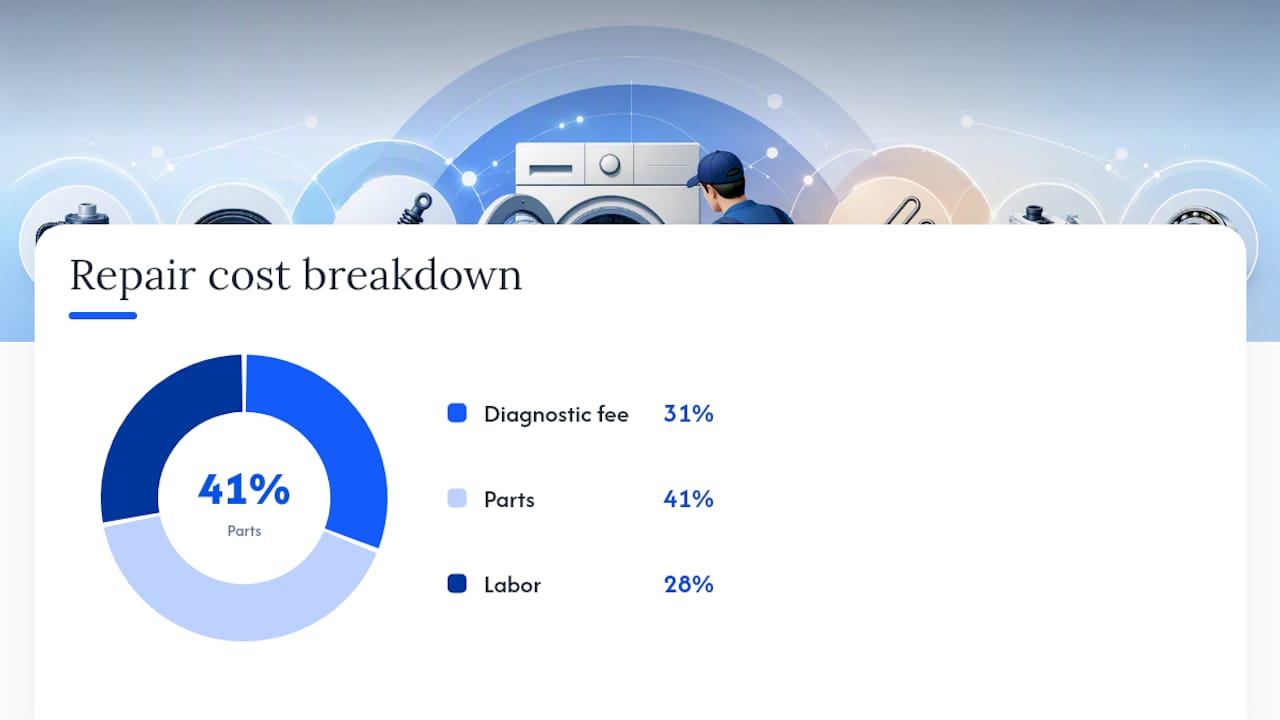
- Diagnostic or service call fee: usually $50 to $150, though some shops fold it into the labor rate instead of billing it separately
- Labor rate: commonly $50 to $150 per hour, varying by region and by how specialized the technician is
- Parts cost: anywhere from $15 for a belt to over $500 for a control board
Region matters more than most homeowners expect. A tech in a major metro area with high overhead might charge $120 an hour, while a rural technician charges $65. Brand matters too. Premium and European brands often use proprietary parts that cost more and take longer to source, which can push an otherwise routine repair well past the averages above.
That’s the number to keep in your head before any technician quotes you a price.
What Does It Cost to Fix Each Washer Part?
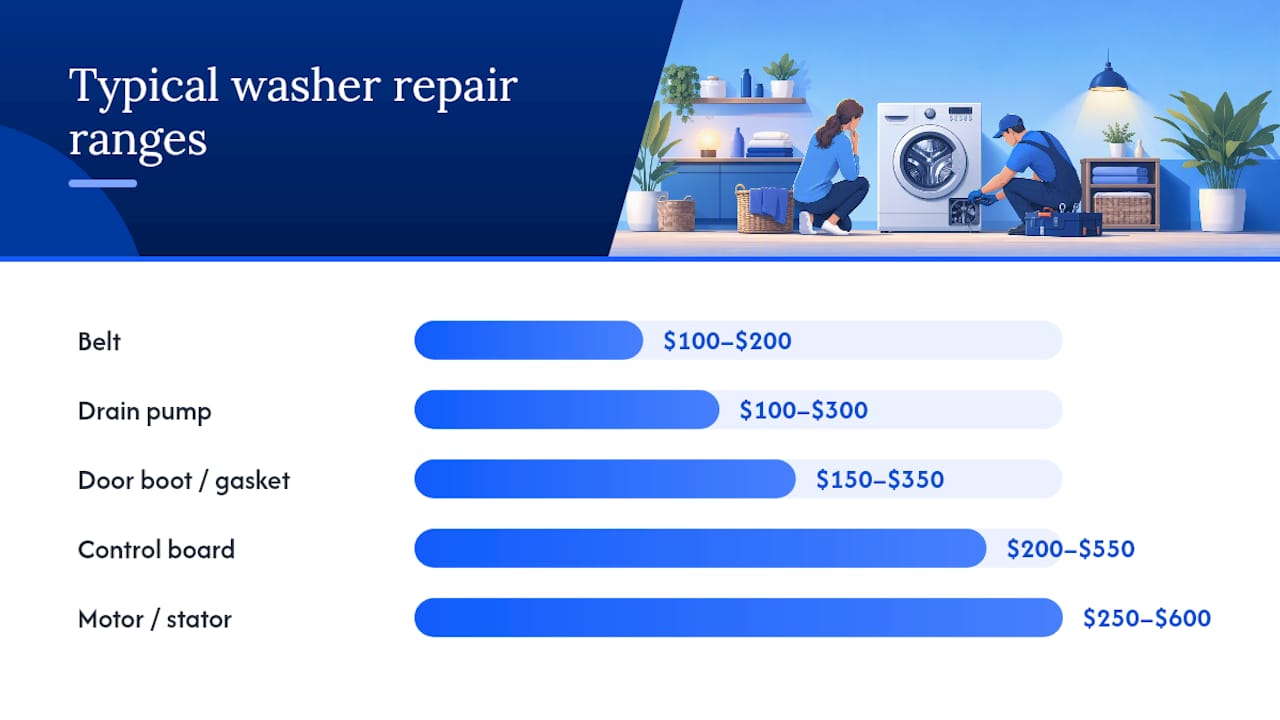
Once a technician tells you what’s broken, you can usually predict the bill within a reasonable range before they even write the invoice. The part determines the cost floor; the labor to access it determines how much higher that floor goes.
Here’s how the most common failures break down, based on cost data from EasyBear’s per-part pricing tables:
- Drain pump ($100–$300): Symptoms include standing water in the drum, a washer that fills but won’t drain, or a loud grinding noise during the spin cycle. Usually a straightforward swap.
- Bearings and seal kit ($250–$520): Loud grinding or squealing during spin, especially on front-load machines, points to worn tub bearings. This is a major teardown job, often requiring the technician to disassemble the entire drum housing.
- Motor or stator ($250–$600): If the drum won’t spin at all, or spins weakly, the motor or its stator assembly may have failed. Labor-intensive because the motor sits deep in the cabinet.
- Control board ($200–$550): Erratic cycle behavior, a machine that won’t power on, or a display showing error codes usually traces back to the electronic control board. Parts alone can run $150 to $400, and boards are model-specific, so sourcing takes time.
- Door boot or gasket ($150–$350): Water pooling under a front-load washer almost always means a cracked or torn door boot. Moderate labor, moderate parts cost.
- Belt ($100–$200): A washer that fills and agitates but the drum doesn’t turn often points to a slipped or snapped belt. One of the cheapest fixes on this list.
- Lid switch ($100–$180): If the machine won’t start at all, check this first. It’s a small, inexpensive part with minimal labor.
- Water inlet valve ($120–$250): Slow filling or no water entering the drum usually means this valve has failed. Easy to access on most models.
- Shock absorbers or suspension springs ($150–$350): Excessive shaking or a walking washer during spin cycle points here, especially on top-load machines.
Notice the pattern: parts that require significant disassembly, like bearings, motors, and control boards, cost two to three times more than parts sitting near the front of the cabinet. A lid switch replacement might take a technician 20 minutes. A bearing job can eat three hours, and that labor bill is what separates a $150 repair from a $500 one.
What Makes a Washer Repair Quote Go Up or Down?
The number on your invoice is really three or four separate charges stacked together, and understanding each one helps you spot where a shop might be padding the bill.
- The diagnostic fee. Some companies charge a flat $70 to $150 just to send a technician out and identify the problem. Others skip that line item but build the cost into a higher hourly labor rate instead. Ask directly: “Is your diagnostic fee credited toward the repair if I approve the work?” A shop that says no on both counts, no separate fee and no credit, is charging you twice without saying so.
- Labor minimums and travel charges. Many companies bill a minimum of one hour even for a 20 minute fix, and some tack on a mobilization or trip charge for rural addresses.
- Parts markup and availability. Technicians typically mark up parts 20% to 50% over wholesale, and that markup runs higher for brands with proprietary components that are harder to source.
- Access difficulty. A washer wedged into a tight closet or stacked with a dryer on top adds labor time before the technician even touches the broken part.
Here’s a realistic example of how those pieces add up: a $150 diagnostic fee, a $200 control board, and 1.5 hours of labor at $90 an hour comes out to $150 + $200 + $135 = $485 total. That’s squarely inside the ranges reported by ConsumerAffairs and Homewyse, and it shows why two shops quoting the “same repair” can land $150 apart depending on how they structure fees.
Pro Tip: Ask for an itemized estimate before any work starts, broken into diagnostic fee, parts, and labor separately. A shop that only offers a single lump-sum number is harder to negotiate with and harder to compare against a second opinion.
Should You Repair or Replace Your Washer?
Consumer Reports built its repair-vs-replace guidance around a simple math check known as the 50% rule: if the repair estimate exceeds about half the price of a comparable new washer, replacement is usually the smarter financial move, especially once the machine is past 10 years old.
Here’s how to run the numbers yourself:
- A new mid-range washer typically installs for $500 to $1,500. Take the midpoint, say $900, and divide by two: $450.
- If your repair quote comes in under $450, fixing it is probably worth it, particularly on a machine under 8 years old.
- If the quote is close to or above $450, and the washer already has some age on it, you’re likely just delaying an inevitable replacement.
A few factors tilt the decision further. If the machine is still under a manufacturer or extended warranty, repair almost always wins by default. If it’s a stacked or integrated laundry unit built into custom cabinetry, replacement gets more expensive and disruptive, which can justify a pricier repair. And a genuinely old machine burns more electricity and water per cycle than a modern one, so ENERGY STAR notes that newer models can shave real money off utility bills over time, a factor worth weighing even when a repair technically clears the 50% threshold.
How Can You Save Money on Washer Repair?
Not every fix requires a service call, and knowing which checks are safe to do yourself can save you the diagnostic fee entirely.
Try these first, with the power unplugged before you touch anything internal:
- Clean out the drain pump filter, a frequent cause of drainage complaints that costs nothing to fix
- Check the drain hose for kinks or clogs and replace it if it’s cracked (a $10 to $20 part)
- Reset the machine by unplugging it for 60 seconds, which clears minor electronic glitches
- Level the washer using a bubble level, since an unbalanced machine causes vibration that mimics a bearing problem
Some jobs are not DIY territory, no matter how many videos promise otherwise. Sealed bearing assemblies, motor replacements, and control board repairs involve either specialized tools, electrical risk, or both. US News recommends leaving those to a licensed technician rather than risking a bigger repair bill from a botched attempt.
Pro Tip: *Ask whether the shop offers used or refurbished parts for older models, especially discontinued components.
Does Washer Type Change the Repair Cost?
Front-load, top-load, and compact washers each fail in different ways, and that changes both the likely cost and how long the repair takes.
- Front-load washers lean on door boots and bearings the hardest. Bearing and seal kit jobs run higher here because the drum sits horizontally and requires more disassembly to access.
- Top-load agitator models tend toward cheaper fixes: lid switches, motor couplers, and clutches are common failures, and most sit near the top of the cabinet for easy access.
- HE top-load washers ditch the agitator for electronic sensors and control boards, which means when something goes wrong, it’s often a pricier electronic part rather than a simple mechanical one.
- Compact and portable units can cost more to repair proportionally, since replacement parts are scarcer and technicians who service them are harder to find in some regions.
How Do You Pick a Trustworthy Washer Repair Company?
A five-minute phone call before you book can save you from a bad experience. Ask these questions upfront:
- Is your diagnostic fee separate, and is it credited toward the repair if I approve the work?
- What’s your warranty on parts and labor, and how long does it last?
- Are your technicians licensed and insured, and can you provide proof?
- What’s your estimated turnaround time for parts on my specific model?
Watch for red flags: a company that only accepts cash with no receipt, one that refuses to give an itemized estimate before starting work, or one that won’t show proof of insurance when asked directly. Any of those should send you looking elsewhere.
Before the technician leaves, get three things in writing: an itemized invoice showing parts and labor separately, your old broken part returned to you, and the exact length and coverage terms of the warranty. Those three items, according to ConsumerAffairs, are the strongest protection you have against being billed for a part that was never actually installed.
Finding a Verified Washer Repair Technician Near You
Cost ranges only help so much when you still have to find someone reliable to send into your laundry room. Bestservicelocal lets you search for appliance repair providers by service type and ZIP code, so you’re only seeing technicians who actually work in your area, not a national directory padded with irrelevant listings.
Every business profile on the platform includes verified details, so you can compare diagnostic fee policies, warranty terms, and customer reviews side by side before you pick up the phone. That comparison view is exactly what this article recommends doing manually, just faster. For homeowners who want to see how Bestservicelocal presents pricing guidance on other home repair categories, the AC installation cost guide follows a similar cost-breakdown approach, and the local business guides hub covers other service categories homeowners search for regularly.
What Homeowners Get Wrong About Washer Repair Costs
The rule is a starting point, not a verdict. A five-year-old washer with a $400 control board repair against a $900 replacement cost sits right at the 50% line on paper, but a machine that young, under warranty or not, is usually still worth fixing because you’re not close to its natural end of life.
What gets underweighted is labor access, not part price. Two repairs with identical parts costs can differ by $200 purely because one requires pulling a washer out of a tight stacked closet and the other sits in an open laundry room. Ask about access difficulty before you ask about the part.
The single best move a homeowner can make isn’t researching part prices online, it’s getting two itemized quotes before approving anything over $200. A second opinion costs one more diagnostic fee and routinely saves multiples of that.
— Service
Get Matched With a Vetted Washer Repair Pro Near You
Bestservicelocal cuts out the guesswork of calling five different repair shops for quotes that never quite match up. 
Search by service type and your ZIP code, and you’ll see verified provider profiles with reviews, warranty terms, and diagnostic fee policies laid out side by side, so you can compare before you ever pick up the phone. That’s the same comparison approach this guide walked through manually, just condensed into one search. If your washer just quit on you, head to Bestservicelocal now, enter your ZIP code, and start comparing local appliance repair technicians in your area today.
Where These Cost Figures Come From
- Consumer Reports — median repair costs by washer type and the interactive repair-vs-replace decision tool (Consumerreports)
- Homewyse — customizable cost calculator factoring local labor rates and contractor overhead (Homewyse)
- ConsumerAffairs — survey of repair professionals on typical price ranges and diagnostic fees (Consumeraffairs)
- EasyBear — per-part cost tables mapping symptoms to likely repairs (Easybear-appliancerepair)
- US News / RealEstate — cost factors and DIY versus professional repair guidance (Realestate)
- ENERGY STAR — energy savings data for modern washers relevant to replacement decisions (Energystar)
Sources
- Should You Repair or Replace Your Broken Washing Machine? - Consumer Reports
- Cost to Repair Washing Machine - Homewyse
- Cost to repair a washing machine - ConsumerAffairs
- Washer Repair Cost: What You’ll Really Pay | EasyBear
- How Much Does It Cost To Repair a Washing Machine? - US News / RealEstate