
How to Verify a Local Business Before You Hire
How to Verify a Local Business Before You Hire

To verify a local business in the US, run six checks in this order: confirm it is registered with the state, confirm it holds any license its trade requires, confirm its insurance with the carrier, confirm the address and phone number are real, cross-check reviews on more than one site, and make sure the quote and contract name the same legal party. Most of this takes less than an hour and costs nothing. Each check catches a different kind of problem, so no single one is enough on its own.
This guide walks through each step, what it proves, what it does not, and what to do when the details do not line up.
TL;DR
- Registration with the Secretary of State proves a business exists as a legal entity. It does not prove it is licensed or good at its work.
- Check trade licenses with your state licensing board, and confirm insurance by calling the carrier, not by trusting a certificate someone hands you.
- Look the address up on a map, call the phone number, and check that the website domain, quote and contract all show the same business name.
- Pressure to decide today, cash-only payment and large upfront deposits are the classic warning signs.
- If the business has no footprint anywhere (no registry entry, no reviews, no complaints record), treat that silence as a red flag.
Table of Contents
- Step 1: Confirm the business is registered
- Step 2: Check the trade license
- Step 3: Confirm insurance directly
- Step 4: Verify the address, phone and website
- Step 5: Cross-check reviews and reputation
- Step 6: Make sure the paperwork matches
- Warning signs that should make you pause
- A 15-minute checklist
- Our perspective
- Find local providers and compare them
- FAQ
- Sources
Step 1: Confirm the business is registered
Start with the legal basics. Every US state keeps a searchable database of registered business entities, usually run by the Secretary of State. A search confirms the entity is recognized as a separate legal person that can sign contracts, open bank accounts and appear in court. Search the name exactly as it appears on the quote or invoice.
What you are looking for:
- Exact name match. The legal name on the registry should match the name on the contract and invoice. A trade name (the “doing business as” name on the truck) may differ, so look for the link between the two.
- Active status. Dissolved, suspended or delinquent entities are worth asking about.
- Registered address and agent. These give you a real place to send paperwork if something goes wrong.
- Formation date. A company created last month that claims 20 years of experience deserves a question. The California Attorney General also suggests checking whether registration data shows a company was created recently or will expire soon.
Keep the limits in mind. State registration confirms the entity exists, not that it is licensed to do its work. Some sole proprietors operate under their own name and never appear in a state entity database, so a missing entry is a reason to ask questions, not proof of fraud. Move on to licensing and see what else turns up.
If you are outside the US, the same idea applies with a different register. Each country keeps its own: Companies House in the UK, ASIC Connect and ABN Lookup in Australia, and provincial registries in Canada, as one verification guide lists by country. The rest of this article uses US tools.
Step 2: Check the trade license
Licensing is separate from registration, and it is where homeowners get hurt most often. Rules differ by state and often by city, so there is no single national lookup. Your options:
- Your state licensing board. Search for your state’s contractor board by name. Many let you look up a license number and see its status, bond and complaint history.
- A directory of state agencies. NASCLA’s Contractor State License Information Directory covers licensing thresholds, agencies and requirements across all 50 states, DC and territories, which helps you find the right office.
- Your city or county. Plumbers, electricians and HVAC technicians are often licensed locally. The local building department can tell you who needs what.
Two examples show what a good lookup returns. In California, all contractor advertisements must carry the state license number, which you can check online or by calling (800) 321-CSLB (2752). The same page suggests asking to see the contractor’s pocket license and picture ID when they arrive at your home. In Washington, the L&I Verify tool shows whether a contractor has an active license, any safety or construction citations, lawsuits against their bond and whether a workers’ comp account is active.
Compare the name on the license with the name on the quote. A valid license number belonging to a different business is a common trick, and the ACCC warns that business cards, registration numbers and other identification do not necessarily prove legitimacy because scammers can fake them. Always look the number up yourself rather than relying on what is printed on a flyer.
For a deeper walk through this stage, see our guide to contractor background checks.
Step 3: Confirm insurance directly
A certificate of insurance on paper is easy to forge or let lapse. The Better Business Bureau advises verifying insurance policies by calling the insurance carrier. Ask the business for the carrier name and policy number, then call the carrier and confirm the policy is active and covers the type of work you are hiring for.
For workers’ compensation, some states let you check online. Washington’s tool above lets you confirm an active workers’ comp account and print the certificate of coverage. Where no tool exists, the carrier call does the same job.
Why it matters: if an uninsured worker is hurt on your property or a crew damages your home, you can end up dealing with the consequences yourself.
Step 4: Verify the address, phone and website
A real local business can be found in the physical world and on the phone. Four quick checks:
- Map it. The ACCC suggests using an online map to see whether the business is really located where it says. A street view showing a vacant lot, a mailbox store or a residential unit that does not match the signage tells you something.
- Call the number. The California Attorney General recommends calling the company’s phone number to make sure someone answers or calls back and that it is not an anonymous call center. A local landline or a number with a local area code, answered by someone who knows the business, is a good sign.
- Read the domain carefully. Scammers can set up fake websites with addresses that look almost identical to the real one, according to the ACCC. Check the spelling, then check that the site has a privacy policy, terms and a complaints process.
- Scan the site for gaps. The California Attorney General lists broken links, blank pages, stock photos and a missing privacy policy or terms as things to notice.
Home-based and mobile providers
Many excellent handymen, cleaners, groomers and trainers work from home and travel to you. A home address is not a red flag by itself. What you want is consistency: the same name, phone number and service area on the website, the state registry or license record, and the business profile. Ask which ZIP codes or towns they cover and how long they have worked there. A provider who gives a clear answer and a license you can verify is a better bet than a storefront with nothing behind it.
Be more careful after storms. The Iowa Attorney General warns that storm-chasing contractors may arrive after a disaster, have business cards printed within an hour and use a temporary address such as a hotel or post office box. If a crew shows up uninvited, take their name and license number and verify them before any work starts.
Step 5: Cross-check reviews and reputation
No single review site tells the whole story. The BBB advises searching for the business’s rating and customer complaints on BBB.org and reading reviews across multiple sites. Also ask for references and call at least two of them. Queensland’s government adds a useful angle: look for testimonials on a website other than the business’s own and ask friends and family about their experiences.

Spotting reviews that look manufactured
The ACCC lists signs that a review may be fake: a short-term spike in very positive or negative reviews, several reviews from the same email or IP address, similar reviewer names, generic reviews with no detail, and similar language across reviews. In practice:
- Real reviews mention the job: the leak under the kitchen sink, the week it took, the cleanup.
- A cluster of five-star reviews in a few days, from profiles with one review each, is worth discounting.
- Look at how the business answers criticism. A calm, specific reply is more reassuring than silence or a rant.
If you use an AI tool to summarize reviews, the BBB says to double-check the summary against reliable sources such as licensing boards and government databases. It is a shortcut for reading, not a verification step.
Also check government complaint records. The Iowa Attorney General’s checklist points to the BBB complaint database, state court records and the state’s registration list, and says that finding no information on a contractor anywhere is a red flag in itself. Your state Attorney General’s consumer office is the place to ask about complaints.
Step 6: Make sure the paperwork matches
The last check happens when you have a quote in hand. The legal name, address, license number and payment details should point to the same business everywhere. One UK legal guide recommends aligning the legal name, company number, registered address, signatory and bank account name across the contract, quote and invoice, and calls inconsistency one of the most common and avoidable problems. The principle holds in any country.
In practice, ask yourself:
- Does the name on the license match the name on the contract?
- Is the check payable to that same name, rather than to an individual?
- Does the contract spell out the scope of work, materials, price, permits, start and finish dates, and who cleans up?
The Iowa checklist recommends getting all of that in writing, with change orders in writing too, reading the contract front and back, and not paying in full until the job is completed to your satisfaction. It also notes a three-business-day right to cancel if you sign at your home. Collecting more than one bid helps here: see how to get multiple quotes for local services. The California licensing board also advises getting at least three written bids.
Warning signs that should make you pause
The Federal Trade Commission lists common tactics of home improvement scammers: knocking on your door because they are “in the area”, pressuring you to decide immediately, asking for full payment up front or cash only, and asking you to pull the permits. Add what the checks above surface:
| What you see | What it may mean | What to do |
|---|---|---|
| No registry entry under the name on the quote | Wrong name, a sole proprietor, or a business that does not exist | Ask for the legal name and license number, then look them up yourself |
| License number belongs to a different company | Borrowed or fake credentials | Walk away until the business explains and the record matches |
| Phone goes to a call center or nobody calls back | No real local presence | Try again at a different time, then move on |
| Address is a hotel, PO box or empty lot | Temporary operator | Verify through the state board and local building department |
| Reviews arrive in a burst with no detail | Possibly manufactured | Look for independent reviews and references |
| Pressure to sign today or pay in cash | Sales tactic | Take the written quote home and compare bids |
If you are comparing options for a repair project, a list of questions to ask a flooring contractor before you sign shows the kind of specifics a trustworthy provider answers without fuss, and the same questions adapt to most trades.
Registration and licenses are a starting point, not a guarantee. The California Attorney General notes that even if licenses and registrations check out, that does not mean a company is trouble-free. Treat the checks as a way to narrow the field, then use judgment on communication, clarity and fit.
A 15-minute checklist
When you are short on time, this order gives you the most information fastest:
- Get the exact legal name, phone, address and license number from the business.
- Search the name in your state’s business entity database.
- Look up the license number with the state or local board and note the status.
- Map the address and call the phone number.
- Search the name with “complaints” and read reviews on at least two sites.
- Call the insurance carrier before work starts.
- Get a written quote with the same name on every page.
For emergency jobs, such as a burst pipe or no heat, you may only have time for steps 3, 4 and 6. Do those, get the price in writing before work begins, and finish the rest while the job is underway.
Our perspective
Most people hunt for a provider in a hurry: the furnace is out, the roof is leaking, the trainer they liked just closed. That is when verification gets skipped, and it is exactly when it matters.
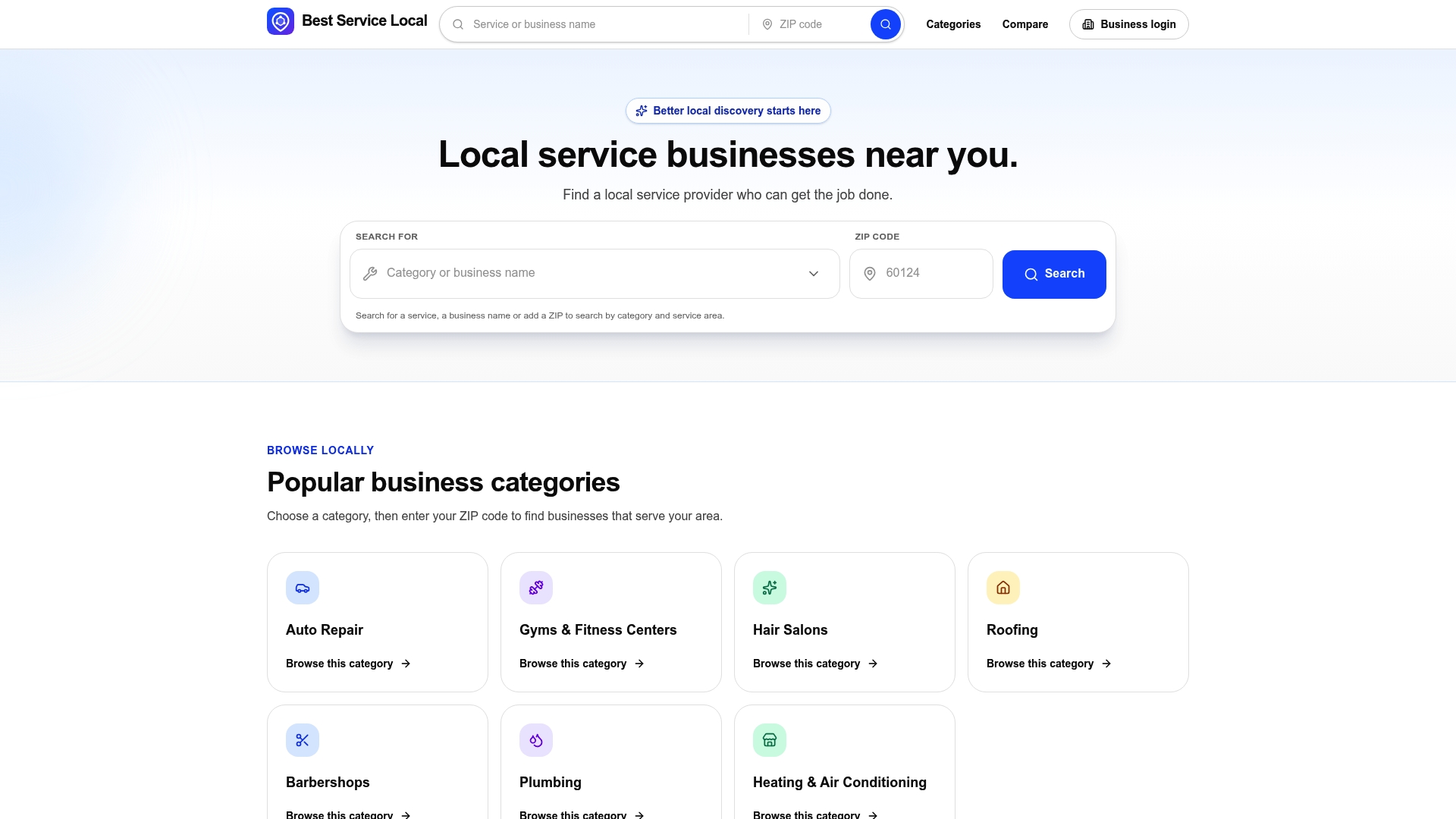
We built Best Service Local around the idea that the first search should already narrow things down to businesses that operate in your area. You search by service type and ZIP code, so you see providers that actually cover where you live, not national call centers or businesses a hundred miles away.
Every business has a profile with verified details, and you can compare several providers side by side. Having name, services and contact options in one place makes the cross-checks in this guide faster: you can match the name on a profile with the name on a quote, then run the state lookups with confidence. Browsing, searching and comparing are free for consumers.
Our view is simple: the best protection is more information, gathered before you commit. Use a profile as the starting point, verify the license and insurance with the official source, and get your terms in writing.
Service
Find local providers and compare them
If you would rather start from a shortlist, search Best Service Local by service and ZIP code. You can browse home repair, automotive, health, beauty, fitness, pet, legal and other local providers, open their business profiles and compare offerings side by side before you reach out.
For handyman work in the Chicago area, you can look at profiles such as Accurate Home Repair in Aurora or Mr. Handyman. Open each profile, note the services and contact details, then run the license and insurance checks above on whichever ones you shortlist. Budgeting for a plumbing job? Our guide to plumber costs and what to ask will help you prepare.
FAQ
How do I check whether a local business is legitimate?
Search its exact name in your state’s Secretary of State business database, then look up any required trade license with the state or local licensing board. Call the phone number, map the address and read reviews on more than one site. Together these checks catch most problems.
How can I verify a business address?
Search the address on an online map and view the street-level image to see whether a real business could operate there. Then call the listed number and ask where the business is located. For home-based or mobile providers, confirm the same address and service area appear on the website, state record and license.
Does state registration mean a business is licensed?
No. Registration confirms the entity exists, not that it can legally perform a regulated trade. Check licensing separately with the board that covers that trade in your state.
What should I do if the details do not match?
Ask the business to explain in writing, for example a trade name different from its legal name. If it cannot, do not proceed until you can confirm its legal status through another reliable source. You can also contact your state Attorney General’s consumer office.
Sources
- Legal Clarity: Is My Business Registered? How to Check and Verify
- California Attorney General: Checking a Company’s Background
- Shufti: How to Check if a Company Is Legit
- NASCLA Contractor State License Information Directory
- California Contractors State License Board: Finding the Right Contractor
- Washington L&I: Verify a Contractor, Tradesperson or Business
- ACCC: Checking a business is genuine
- Better Business Bureau: How to research any business before you buy
- Iowa Attorney General: Contractor Checklist
- Queensland Government: Knowing if a business is legitimate
- Sprintlaw: How to Check a Business Registration in the UK
- FTC: How To Avoid a Home Improvement Scam
- Questions to Ask a Flooring Contractor Before You Sign