
$20–$75 Tire Repair Cost: Itemized Out the Door Prices Drivers Pay
$20–$75 Tire Repair Cost: Itemized Out the Door Prices Drivers Pay
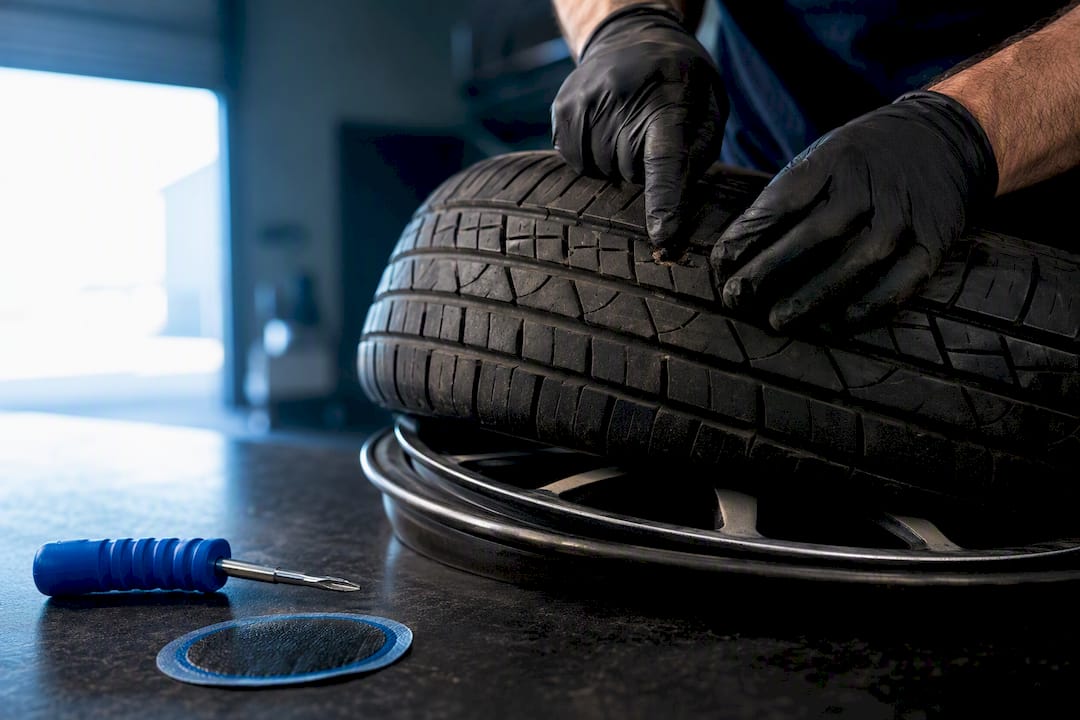
Most punctured tires cost between $20 and $75 to fix professionally, with a properly done patch-plug combo landing around $20 to $45 at most shops. That combo method, which patches the inside liner and plugs the puncture channel, is the industry standard for a permanent fix. If the damage sits on the sidewall, shoulder, or is beyond typical repairable limits, replacement with a new tire is recommended.
TL;DR:
- Reputable shops primarily use a patch-plug combo for $20 to $45 to ensure a permanent and safe repair.
- Repair costs vary sharply depending on tire type, location, and whether additional services like sensor relearn or mobile service are involved.
- A patch-plug repair generally preserves tire lifespan when done correctly and on a suitable puncture location, unlike a plug-only fix.
- Additional fees like disposal, taxes, and service charges often raise the final cost beyond the initial quote, so confirm the total beforehand.
- For best value, compare local shops on verified platforms to ensure a proper repair with warranty coverage and transparent pricing.
Table of Contents
- How Much Does Tire Repair Cost by Method?
- What Makes Your Tire Repair Quote Go Up or Down?
- Plug, Patch, or Patch-Plug Combo: Which One Is Actually Safe?
- What Shows Up on a Tire Repair Invoice
- How to Get a Fair Price on Tire Repair
- Does Tire Repair Come With a Warranty?
- Does a Repair Shorten Your Tire’s Lifespan?
- Watch for Extra Fees, Taxes, and Environmental Charges
- Repair Now or Replace Later? The Real Cost Comparison
- The Real Question Isn’t Price, It’s Whether the Repair Holds
- Compare Local Tire Shops Before You Commit to a Price
- Where These Numbers Come From
- Sources
- FAQ
How Much Does Tire Repair Cost by Method?
The price you pay depends almost entirely on which repair method the shop uses, and that’s where a lot of drivers get confused by wildly different quotes for what sounds like the same job.
A basic plug, the kind you might do yourself on the shoulder of the highway, costs $8 to $20 in materials if you buy a kit and do it yourself. At a shop, a plug-only repair (rare, since most professionals won’t do plug-only work) runs similar territory, often under $30. It’s fast, it’s cheap, and it’s meant to get you home, not to last for the life of the tire.
An internal patch, applied to the inside of the tire after dismounting, typically costs $15 to $45, according to pricing data from Tire Advise. Some retailers, including big-box tire chains, will do this for free if you bought the tire from them.
The patch-plug combo is where most reputable shops land, and for good reason. It combines a plug through the puncture with a patch sealing the inner liner. Jerry’s cost analysis puts this at $20 to $45 per tire in most markets, climbing to $40 to $75 in high-cost cities or on larger, specialty tires. Kelley Blue Book’s service guide reports an average closer to $54 to $64 once you factor in mounting and balancing, which most shops bundle into the total rather than list separately.
Replacement changes the math completely. A standard passenger tire typically runs $80 to $200 per tire before mounting and balancing, while performance, off-road, or specialty sizes push well past $250. Add mounting, balancing, and disposal, and a full tire swap can easily hit $150 to $350 once everything’s on the invoice.
- Plug only (DIY kit): $8 to $20 in materials
- Internal patch: $15 to $45 at a shop
- Patch-plug combo: $20 to $75 depending on location and tire type
- Standard passenger tire replacement: $80 to $200 per tire, before labor
- Specialty or performance tire replacement: $250 and up per tire
What Makes Your Tire Repair Quote Go Up or Down?
Two shops three miles apart can quote wildly different prices for the exact same puncture, and it’s rarely random. A handful of variables drive most of the swing.
Tire type matters first. Standard passenger tires are the cheapest to work on because every shop stocks common patch materials and has done thousands of them. Run-flat tires, off-road tires with reinforced sidewalls, and low-profile performance tires often carry a surcharge because they take more time to dismount safely and sometimes require specialized equipment.
Location is the next biggest factor. Survey data from SUNSOUL shows urban shops charging roughly 20% to 45% more than rural ones for the same standard puncture repair, a gap driven by rent, wages, and local demand rather than anything about the actual repair work.
Mobile tire service adds real convenience but at a real cost. Having a technician come to your driveway or office parking lot typically tacks on a call-out fee on top of the repair itself, so compare that total against a shop visit before you book.
If your vehicle has a tire pressure monitoring system, a sensor knocked loose or damaged during the repair adds a separate line item, and relearning the sensor to the vehicle’s computer sometimes requires dedicated tools.
Sealant is the wildcard most drivers forget about. If you or a previous owner used an aerosol sealant like Fix-a-Flat, that residue often adds cleanup labor, and some shops will refuse the repair outright if the sealant compromised the tire’s internal structure.
- Specialty and run-flat tires often carry a repair surcharge
- Urban shops run 20% to 45% higher than rural shops on average
- Mobile service adds a call-out fee on top of the repair cost
- TPMS sensor issues add a separate charge, sometimes with a relearn fee
- Aerosol sealant residue can add cleanup labor or trigger a refusal
Pro Tip: Tell the shop upfront if you’ve ever used a can of sealant on that tire, even months ago. Disclosing it costs you nothing, but hiding it can void a repair warranty or waste your time if they discover it mid-job and have to renegotiate the price.
Plug, Patch, or Patch-Plug Combo: Which One Is Actually Safe?
Not every fix is built to last, and knowing the difference matters more than knowing the price.
- Plug only. A rubber plug gets forced into the puncture channel from outside the tire. It’s fast and cheap, but most tire manufacturers and safety standards don’t consider it a permanent repair since it does nothing to seal the inner liner.
- Internal patch. The tire comes off the wheel, the technician inspects the inside for hidden damage, and a patch is glued over the puncture from the inside. This addresses the liner but leaves the puncture channel itself unsealed against moisture.
- Patch-plug combo. This is the method most reputable shops insist on. The tire is dismounted, the interior inspected, a combination unit is installed through the puncture and against the liner, and the wheel is remounted and rebalanced. It meets the safety standard most manufacturers reference for a permanent fix.
Some damage disqualifies the tire from repair entirely, no matter which method you’d prefer. Sidewall punctures, damage near the shoulder, cuts wider than about a quarter inch, or any spot where you can see the internal belts means it’s replacement time, not repair time. A DIY roadside plug can get you to the next exit safely, but it’s a stopgap, not a solution. Skipping the rebalancing step after a shop repair, which some rushed shops do to save time, is a common corner-cut that can leave you with a vibration at highway speed even after the puncture itself is fixed.
What Shows Up on a Tire Repair Invoice
A repair quote that looks cheap on the phone can grow fast once every line item lands on paper. Here’s what typically shows up, and which pieces are usually bundled into a flat rate versus billed separately.
| Line Item | Typical Cost Range | Usually Bundled? |
|---|---|---|
| Patch-plug combo repair | $20–$75 | Base service |
| Mounting/dismounting | $8 to $20 | Often bundled |
| Wheel balancing | $15–$30 per wheel | Often bundled |
| Valve stem replacement | $3–$15 | Sometimes extra |
| TPMS sensor replacement | $50–$150 | Usually extra |
| Mobile call-out fee | $30–$75 | Always extra |
| Sealant cleanup | under $30 | Extra if applicable |
| Tire disposal | $3–$8 | Sometimes extra |
These figures come from aggregated cost data compiled by Cost Insider alongside pricing from Jerry and SUNSOUL. Ask for the total out-the-door price before work begins, not just the base repair fee, since valve stems and disposal charges have a way of appearing only on the final receipt.
How to Get a Fair Price on Tire Repair
Getting a fair quote comes down to asking the right questions before the technician touches the tire, not after.
- Ask specifically for a patch-plug combo, not a plug-only fix, if the shop doesn’t volunteer the method.
- Ask whether mounting, balancing, and disposal are included in the quoted price or billed separately.
- Ask if the tire qualifies for a free repair, since some retailers waive the fee if you bought the tire there.
- Get two written, itemized quotes if the first one feels vague, and compare line by line rather than by the bottom number alone.
- Treat a quote with no mention of balancing or inspection as a red flag. Skipping those steps is how shops cut corners.
Pro Tip: If a shop quotes a flat “$25 flat” with no breakdown, ask them to itemize it anyway. A legitimate shop can tell you exactly what that $25 covers in under thirty seconds.
Does Tire Repair Come With a Warranty?
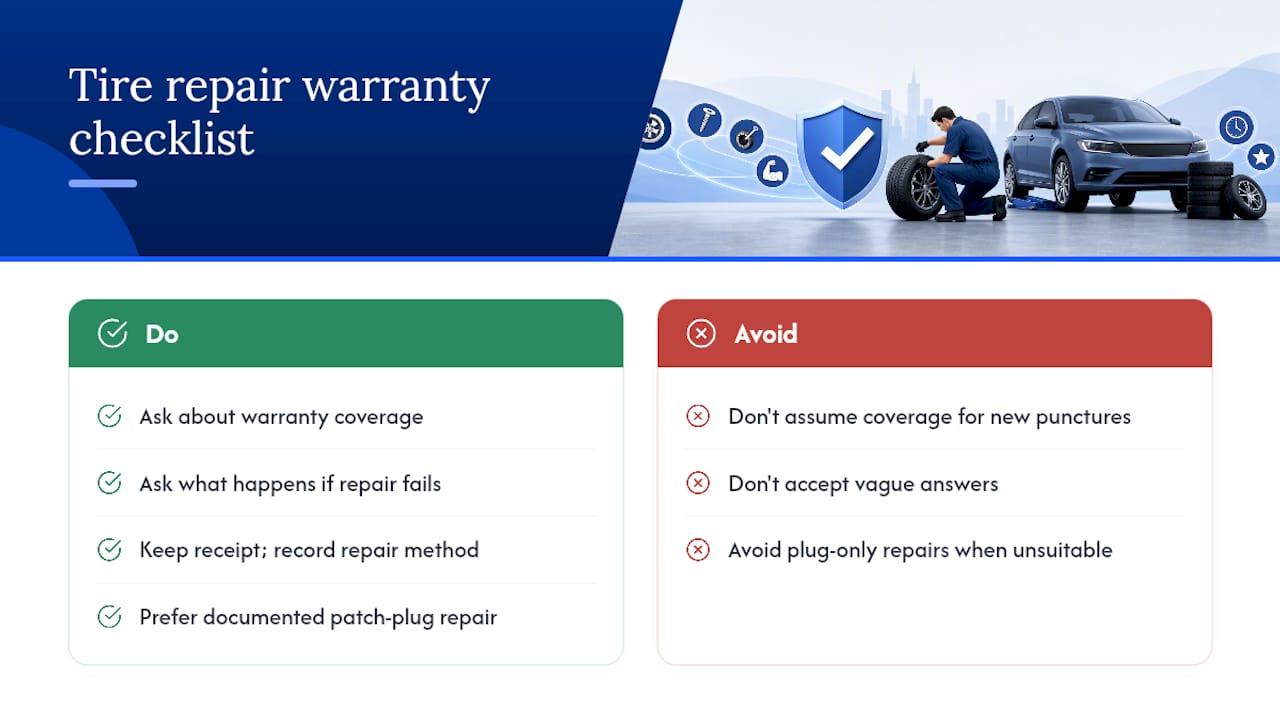
Warranty coverage on a tire repair varies more than most drivers expect, and it’s worth asking about before you agree to the price. Many national tire chains back their patch-plug combo repairs with a workmanship guarantee, sometimes for the life of the tire, meaning if that same puncture leaks again, they’ll redo the repair at no charge or apply the original repair cost toward a replacement.
Independent shops handle this less consistently. Some offer a 30 to 90 day guarantee on workmanship, others offer none at all beyond verbally standing behind the job. Ask directly: “If this repair fails in three months, what happens?” A shop that hesitates or gets vague is telling you something.
Warranty coverage typically has limits worth understanding upfront. It usually only covers the original puncture location, not a new puncture elsewhere on the tire. It usually requires the tire to still be within its tread-wear window. And it almost always excludes damage from sidewall impacts, curbing, or a second puncture that happens after the repair.
If the tire itself carries a manufacturer’s road hazard warranty from when you bought it, an improper repair, like a plug-only fix on a puncture that should have gotten a patch-plug combo, can void that warranty entirely. That’s one more reason the cheapest quote isn’t automatically the smartest one. Keep your receipt and ask the shop to note the repair method used, since that documentation matters if you ever need to make a warranty claim later.
Does a Repair Shorten Your Tire’s Lifespan?
A properly executed patch-plug combo repair, done in the right location, has minimal impact on how many miles you get out of that tire. The puncture channel gets sealed and the liner gets patched, and the tire goes back to doing its job normally. Where lifespan actually takes a hit is in the shortcuts.
A plug-only repair left in place long-term, rather than as an emergency stopgap, leaves the inner liner exposed to slow air seepage and moisture intrusion, which can accelerate belt separation over time. Skipping the rebalancing step after any repair creates uneven wear patterns, since a wheel that’s even slightly out of balance wears the tread unevenly and can shave months off the tire’s useful life.
Repair location on the tire also plays a role most drivers never consider. A puncture near the center of the tread repairs cleanly and holds up well. A puncture close to the shoulder, even if it’s technically within repairable limits, puts more stress on the patch during cornering and can fail sooner than a center repair would.
The bigger lifespan risk isn’t the repair itself. It’s neglecting the tire afterward. A repaired tire that runs underinflated, or one that never gets rotated on schedule, will wear out faster regardless of how well the original patch-plug combo was done. Treat a repaired tire exactly like you’d treat any other tire on the car: check pressure monthly, rotate on schedule, and you’ll get full life out of it.
Watch for Extra Fees, Taxes, and Environmental Charges
The number quoted over the phone rarely matches the number on your final receipt, and the gap usually comes from fees that aren’t part of the repair itself.
Sales tax applies to both parts and labor in most states, and rates vary enough by location that a repair quoted at $45 could land closer to $48 to $50 after tax depending on where you are. Some states also tack on shop supply fees, typically a small flat charge or percentage meant to cover disposable materials like gloves, cleaning solvents, and rubber cement that don’t get itemized individually.
Environmental or disposal fees show up specifically when a tire gets replaced rather than repaired. Most states mandate a tire disposal fee, usually just a few dollars per tire, that funds proper recycling or disposal of the old tire. This fee applies to replacement, not repair, so it shouldn’t appear on a straightforward patch-plug combo invoice.
Shop supply fees and hazardous waste fees are the ones most likely to catch drivers off guard, since they’re small individually but add up when combined with tax, as explained in this dealership fees breakdown. Ask for the full out-the-door number, including tax and any fees, before you approve the work rather than after. A reputable shop will give you that number without hesitation, and if one won’t, that’s worth noting before you hand over your keys.
Repair Now or Replace Later? The Real Cost Comparison
A $30 to $75 repair sounds like an easy win against a $150 to $350 replacement, and for a single eligible puncture, it usually is. The math gets more interesting when you zoom out to the full life of the tire rather than just this one incident.
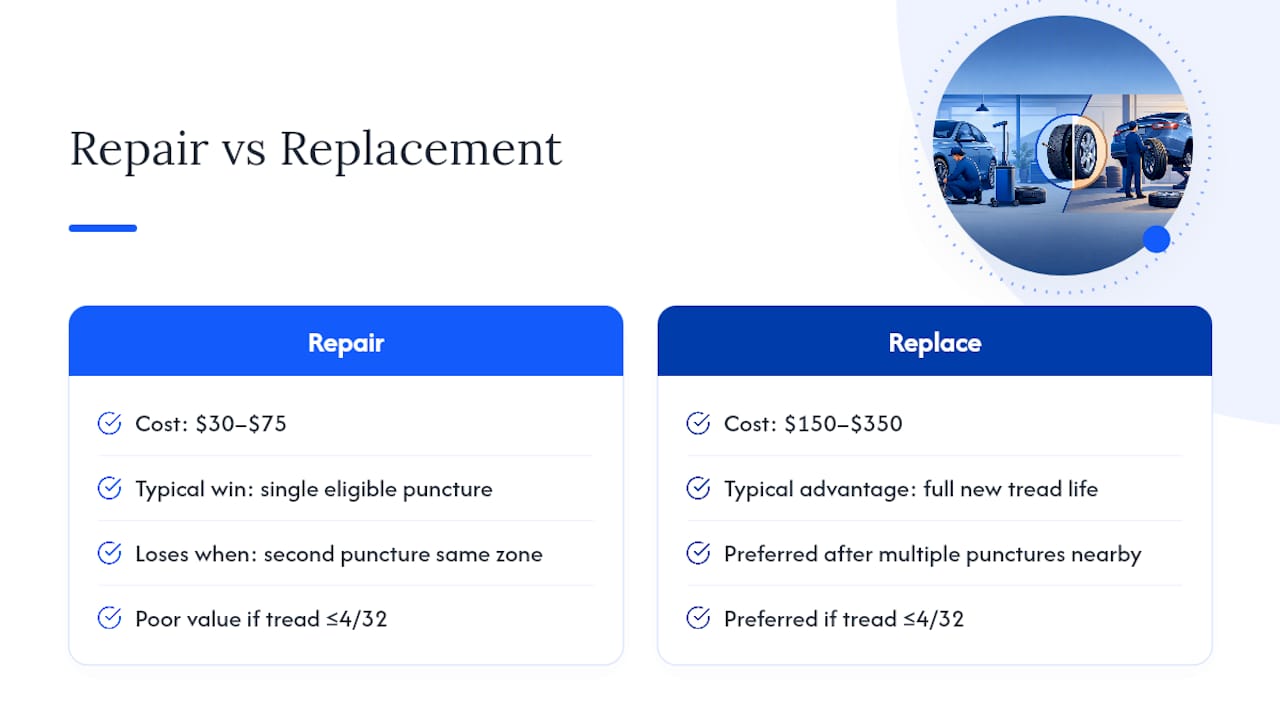
If a tire has already been repaired once and picks up a second puncture, especially one close to the first repair, most shops won’t touch it a second time in the same zone. That’s the moment repair stops being the cheaper option, because you’re paying for a temporary patch on a tire that’s likely heading toward replacement anyway within a few thousand miles.
Tread depth changes the calculation too. A tire already down to 4/32 or less is a different story. Spending $40 to repair a tire that needs replacing in another 5,000 miles regardless just delays an expense you’re going to pay anyway, and now you’re paying for both.
Run the numbers the way a mechanic would: repair cost divided by remaining tread life versus replacement cost divided by full tread life. A $45 repair on a tire with 60% tread left is a clear win. A $45 repair on a tire with 15% tread left, especially if it’s an older tire showing sidewall cracking, is often money spent postponing an inevitable purchase. When in doubt, ask the shop to check tread depth and overall tire condition, not just the puncture, before you commit to either path.
The Real Question Isn’t Price, It’s Whether the Repair Holds
Every driver wants the cheapest fix, but the cheapest fix and the safest fix aren’t always the same tire. A patch-plug combo done right costs more than a roadside plug, and it’s worth every extra dollar because it’s the difference between a permanent repair and a temporary one you’ll pay for twice. Comparing verified local shops on Bestservicelocal before you commit gives you a clearer picture of who actually does the job properly, not just who answers the phone fastest.
— Service
Compare Local Tire Shops Before You Commit to a Price
Getting quotes from three different shops over the phone eats up your afternoon, and half the time nobody tells you upfront whether they’re doing a real patch-plug combo or just plugging it and hoping. Bestservicelocal lets you search by service type and ZIP code so you’re comparing shops that actually work in your area, not a national directory of numbers nobody answers.

Every business profile on the platform includes details such as ratings, contact information, and booking options side by side before you decide who gets your keys. That side-by-side comparison is the whole point. Instead of calling five shops and writing down five different quotes on a napkin, you pull up the profiles, compare what each one actually offers, and reach out to the one that fits your budget and your timeline. If you’re weighing a repair against a full tire replacement, the same search works for tire shops that handle both, so you’re not stuck choosing blind. Search your ZIP code on a local service marketplace and start comparing local tire repair providers before your next flat turns into a guessing game.
Where These Numbers Come From
The cost ranges and safety guidance in this article draw from pricing analyses at Jerry and Kelley Blue Book, repair breakdowns from Tire Advise and Cost Insider, state-level survey data from SUNSOUL, and repair-process reporting from Diesel World and TorqueNews.
Sources
- Tire plug or patch repair cost - Jerry
- Tire Repair Costs - Kelley Blue Book
- How Much Does It Cost To Get A Tire Patched - Tire Advise
- Why your tire may not be repairable - TorqueNews
- How Much Does Tire Repair Cost by State - SUNSOUL
FAQ
How much does it usually cost to patch a tire?
A professional patch typically costs $15 to $45, while a patch-plug combo, the more durable option, runs $20 to $75 depending on your location and tire type.
How much does it cost to repair a punctured tire overall?
Total out-the-door cost, including mounting and balancing, usually falls between $20 and $75 for a standard patch-plug combo, with Kelley Blue Book reporting an average closer to $54 to $64 once labor is included.
How much does it cost to patch a tire at a retailer like Walmart?
Pricing varies by location and isn’t standardized, but many big-box retailers charge in the same $15 to $45 range as independent shops, and some offer free repairs if you purchased the tire there.
Is it worth fixing a flat tire instead of replacing it?
Yes, if the puncture is in the tread area, smaller than a quarter inch, and the tire still has solid tread life remaining. Sidewall damage, shoulder punctures, or a tire already worn down makes replacement the smarter long-term choice.