
Tankless vs Tank Water Heaters: Which One Fits Your Home?
Tankless vs Tank Water Heaters: Which One Fits Your Home?
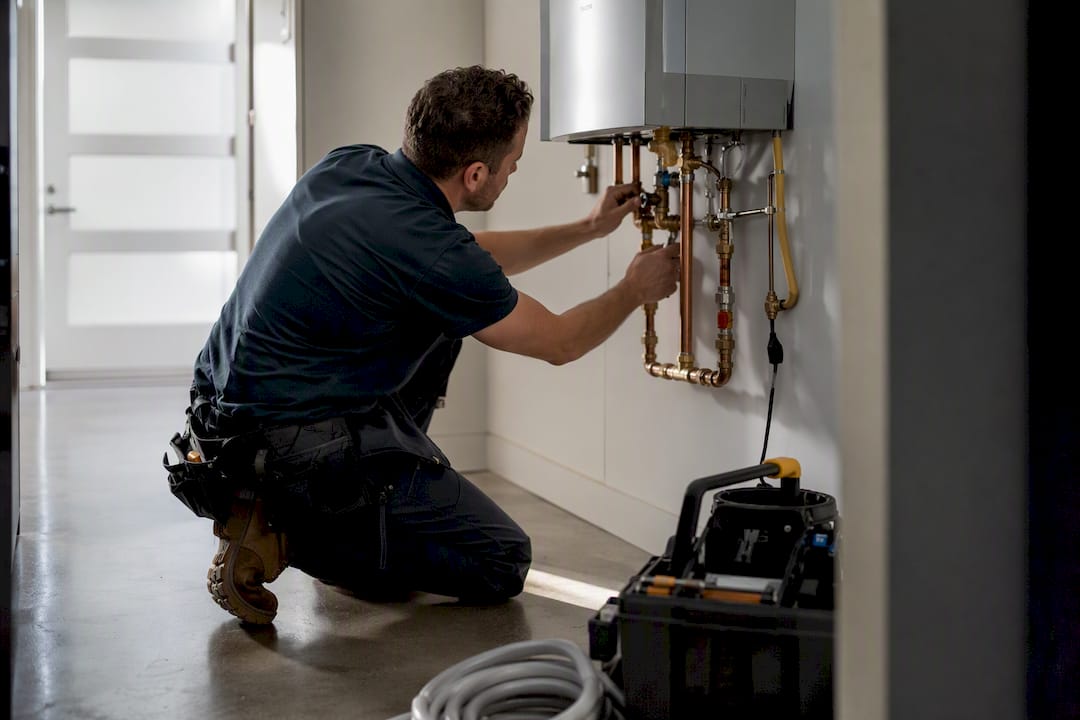
If you live alone or with one other person, a tankless water heater usually wins on long-term value. Families of four or more often do better with a tank, unless you’re willing to pay for two tankless units or a high-flow model. All-electric homes should look hard at a heat pump tank before choosing electric tankless. Short-term owners flipping or renting out a property almost always come out ahead with a tank, since the upfront cost is lower and the payback window on tankless doesn’t have time to work.
- Efficiency: the Department of Energy puts tankless efficiency gains at 24% to 34% for low-use homes.
- Trade-off: tankless trades a higher upfront bill and possible retrofit costs for lower operating costs and unlimited hot water; tanks trade cheaper installation for standby losses and a shorter lifespan.
Key Takeaways
Choosing between tank and tankless comes down to matching household usage, fuel type, and ownership horizon to the technology’s real strengths, not its marketing.
| Point | Details |
|---|---|
| Match usage to technology | Low-use single or two-person households see the biggest DOE efficiency gains from tankless, 24% to 34%. |
| Budget for retrofits, not just the unit | Gas-line upsizing, venting, and panel upgrades often cost more than the water heater itself. |
| Size by GPM and temperature rise | Add up fixture GPMs and check winter-adjusted output, not the unit’s best-case rating. |
| Maintenance protects lifespan | Annual tank flushing or 6 to 9 month tankless descaling in hard water prevents early failure. |
| Get comparable quotes first | Use Local AI Page to find local, verified installers by ZIP code and request itemized pricing before deciding. |
Table of Contents
- Tankless vs Tank Water Heater: The Quick Comparison
- How Tank and Tankless Heaters Actually Work
- What Tankless vs Tank Really Costs to Install
- Getting the Sizing Right (So You Don’t Regret It)
- Maintenance and How Long Each Type Really Lasts
- Your Decision Checklist by Household Type
- Finding an Installer You Can Trust
- A Homeowner-First Closing Note
- Compare Local Installers Before You Choose
- Sources
Tankless vs Tank Water Heater: The Quick Comparison
Here’s the side-by-side version, stripped down to what actually changes your monthly bill and your ten-year outlook.
- Efficiency: Tankless units run 24% to 34% more efficient for homes using 41 gallons a day or less, per the DOE, but that edge shrinks to 8% to 14% in high-use households pulling around 86 gallons daily.
- Cost: Tanks cost less to buy and install; tankless units cost more upfront and often trigger retrofit expenses.
- Lifespan: Tankless units typically run 20 years or more, according to Home Energy Decisions, while tanks last roughly 8 to 15 years.
- Space: Tankless units mount on a wall and free up floor space; tanks need a closet or utility room footprint.
- Supply: Tankless delivers endless hot water but caps out at a fixed flow rate; tanks store a finite supply that can run out during heavy simultaneous use.
How Tank and Tankless Heaters Actually Work
A storage tank keeps 30 to 80 gallons of water hot around the clock, reheating it as it cools and as you draw from it. That constant reheating is called standby loss, and it’s the main reason tanks use more energy than they need to. Recovery rate (how fast it reheats after a big draw) determines whether you run out of hot water during back to back showers.
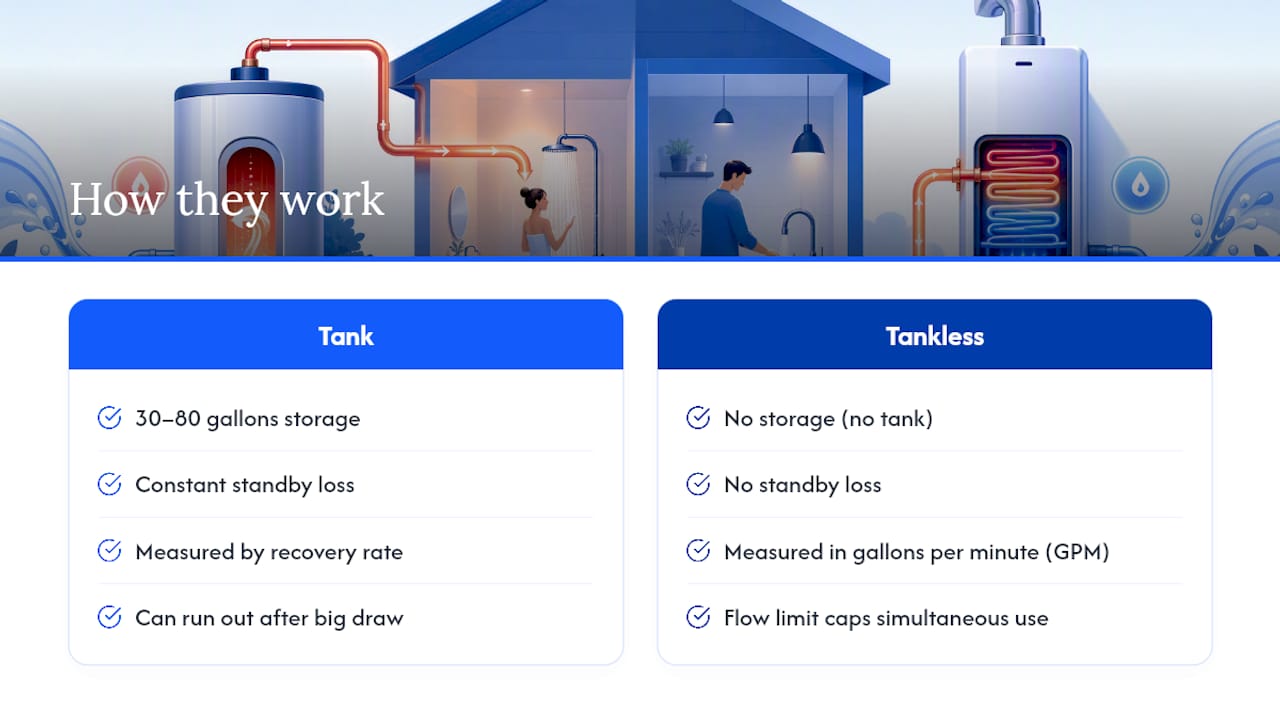
A tankless unit skips storage entirely. Cold water passes through a heat exchanger, and a gas burner or electric element heats it instantly as it flows. That’s why tankless output gets measured in gallons per minute (GPM) rather than gallons stored. There’s no reservoir to deplete, but there’s a ceiling on how much flow the unit can heat at once.
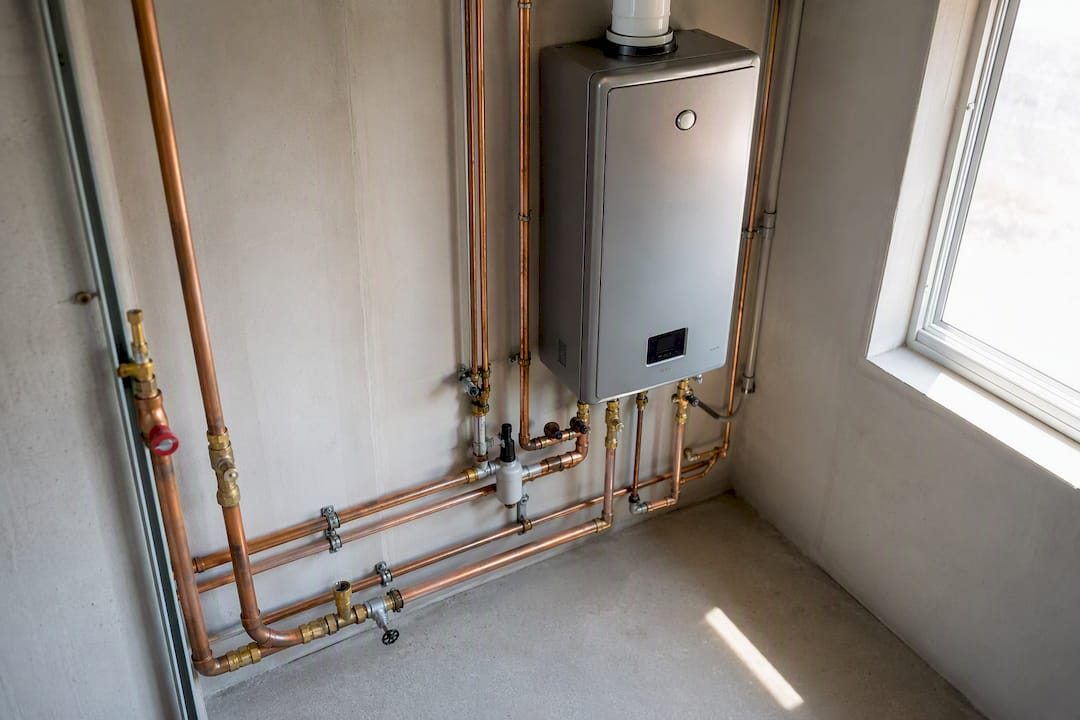
Homeowners also choose between point-of-use tankless units (small, installed near one fixture) and whole-house models that serve the entire home from a single, larger unit.
What Tankless vs Tank Really Costs to Install
Sticker price is the smallest part of this decision. A gas tank heater typically installs for $800 to $1,800. Electric tanks run similar, often $700 to $1,600. Gas tankless units land between $1,500 and $3,500 installed, and electric tankless between $1,000 and $2,500. Heat pump tanks, a strong option for all-electric homes, usually run $1,800 to $3,300 installed.
The real cost driver isn’t the unit. It’s the retrofit work most homes need to switch to gas tankless:
- Upsizing the gas line to handle a bigger burner, often several hundred dollars.
- Adding new venting and a condensate drain for high-efficiency condensing models.
- Upgrading the electrical panel for electric tankless, since these units draw far more amperage than a standard tank.
Fewer dollars saved than you’d think: water heating makes up only about 20% of a typical home’s energy use, so even a 30% efficiency gain on that slice often translates to $80 to $200 a year in savings, not a dramatic drop in your utility bill.
Before you sign anything, check the ENERGY STAR rebate finder and your state’s listing on DSIRE. Utility rebates can shave hundreds off the net installed cost and shorten your payback timeline considerably.
Getting the Sizing Right (So You Don’t Regret It)
Sizing mistakes cause more tankless dissatisfaction than any other issue, usually because installers quote a unit’s headline GPM without adjusting for your winter groundwater temperature, according to one installation trade-off analysis. Here’s how to size correctly for each type:
- For tanks: match storage gallons and first-hour rating to household size. A single person is usually fine with 30 to 40 gallons; a family of four typically needs 50 to 80 gallons with a first-hour rating around 60 to 80 gallons.
- For tankless: add up the GPM of fixtures you’ll run at once, then check the unit’s rated GPM at your region’s winter incoming water temperature, not its best-case rating.
- Run the math on a real scenario: two showers (roughly 2.5 GPM each) plus a dishwasher (about 2 GPM) adds up to nearly 7 GPM. Many whole-house tankless units only deliver 5 to 8 GPM at a 70 degree rise, so cold climates often need two units or a larger model.
- Solve long pipe runs with a point-of-use unit near a distant bathroom or a recirculation loop, rather than oversizing the main unit.
Maintenance and How Long Each Type Really Lasts
Tankless units need annual descaling in normal water, or every 6 to 9 months if you have hard water, since mineral buildup damages the heat exchanger over time. A DIY descaling kit runs $30 to $50; a professional service call typically costs $100 to $200. Skipping this in a hard-water area can void your warranty, since manufacturers often require documented maintenance or a softener, according to Home Energy Decisions.
Tanks need less frequent attention: an annual flush to clear sediment and a periodic anode rod check to prevent corrosion. Corrosion is the tank’s real failure mode, and it tends to end in a slow leak or, worse, a sudden flood rather than a gradual performance drop.
- Tankless: 20+ years with proper descaling, per Home Energy Decisions.
- Tank: 8 to 15 years, shorter in hard water or with a neglected anode rod.
Pro Tip: If you’re in a hard-water region, install a water softener before your tankless unit goes in, not after. It’s cheaper to protect the heat exchanger from day one than to descale a neglected unit that’s already scaling internally.
Your Decision Checklist by Household Type
Match your situation to the choice that tends to work best:
- Single person or couple: tankless usually pays off since low daily usage maximizes the DOE’s 24% to 34% efficiency range.
- Family of four or more: a tank, or two tankless units, handles simultaneous showers and laundry better.
- All-electric home: consider a heat pump tank over electric tankless, since electric tankless often needs an expensive panel upgrade.
- Short-term owner or flipper: a tank keeps upfront cost low and doesn’t ask a future buyer to understand a new system.
Three questions to ask every installer:
- Is the gas line, venting, and any electrical work itemized separately from the unit price?
- What’s the maintenance schedule, and does my water quality change it?
- Is a permit included, and who pulls it?
Red flags: a verbal-only quote with no line items, and a bid that skips a home water-usage assessment entirely.
Finding an Installer You Can Trust
Before hiring anyone, confirm they’re licensed, insured, and willing to provide references and a permit confirmation in writing. Local AI Page lets you search installers by ZIP code, compare verified profiles and service areas, and reach out directly, so you can line up two or three itemized quotes side by side instead of guessing from a single visit.
A Homeowner-First Closing Note
Correct sizing and an honest, itemized quote matter more than which technology you pick. Plan a replacement before your old unit fails; emergency installs almost always cost more and leave less room to compare options.
— Local AI Page
Compare Local Installers Before You Choose
Water heater replacement is one of those projects where the contractor matters as much as the equipment. Local AI Page is built for exactly this moment: search by ZIP code, browse verified business profiles, and see service areas and contact details side by side instead of calling around blind.
Request at least two line-item quotes before you decide between tank and tankless, and ask each installer directly who’s responsible for pulling permits. If you’re comparing options in the Chicago suburbs, start with local listings for Lombard, Wheeling, or Barrington, or browse installers by location anywhere else in the country.
Sources
For efficiency figures, testing data, and rebate eligibility, check the DOE, Consumer Reports, ENERGY STAR’s rebate finder, and DSIRE for your state’s current incentives before finalizing your budget.