
$600–$1,500 Typical: Real Estate Attorney Fees for Homebuyers
$600–$1,500 Typical: Real Estate Attorney Fees for Homebuyers

Most residential closings run $600 to $1,500 in flat attorney fees, with major metro markets like New York seeing $2,000 to $3,500. Flat-fee billing is the norm for standard home purchases; hourly rates ($300 to $650) apply mostly to commercial deals or anything with a title dispute. The attorney fee is just one line item. Title insurance, recording fees, and transfer taxes usually cost more than the lawyer does.
TL;DR:
- Flat-fee residential closings typically range from $600 to $1,500, with higher costs in major markets like New York exceeding $3,500.
- Commercial real estate transactions usually bill hourly at rates between $300 and $650, with total costs often reaching into the thousands for complex deals.
- The attorney’s fee generally accounts for only 20 to 30 percent of total closing costs, with title insurance and taxes representing larger expenses.
- Flat fees cover standard work such as contract review and document preparation, while additional costs like title insurance and recording fees are billed separately.
- Comparing quotes requires clarifying scope, billing structure, and limits in writing, as well as vetting all professionals involved through verified local listings.
Table of Contents
- What Do Real Estate Attorney Fees Typically Cost?
- How Do Attorneys Structure Their Fees?
- What’s Included in the Fee, and What Gets Billed Separately?
- Who Pays, and Does Your State Even Require a Lawyer?
- How Do You Compare Quotes and Spot a Bad Deal?
- Using Verified Listings to Vet Real Estate Professionals
- The Editorial Take: Budget the Range, Then Ask the Right Questions
- Ready to Compare Vetted Local Professionals?
- Sources
What Do Real Estate Attorney Fees Typically Cost?
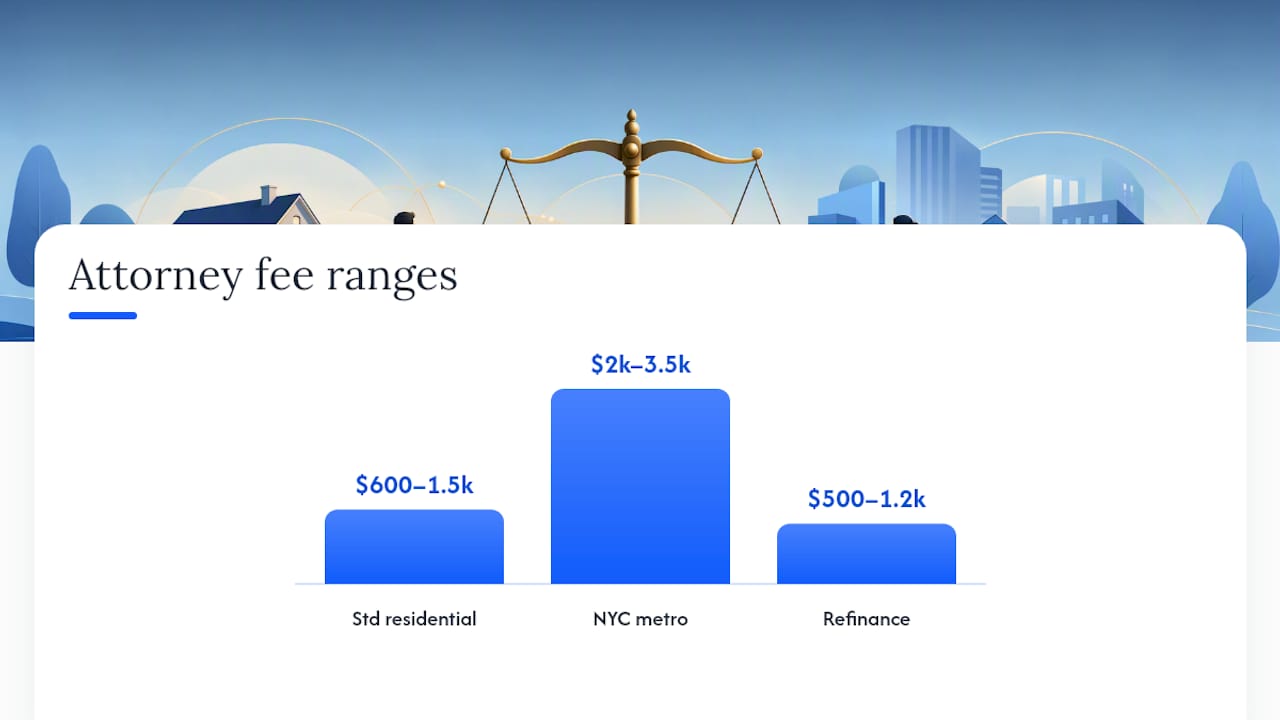
The national range for a standard residential closing lands between $600 and $1,500, and that figure holds up across most suburban and rural markets regardless of whether you’re buying or selling. Push into a dense metro area and the number climbs fast: New York City closings commonly run $2,000 to $3,500 for a routine residential purchase, driven by co-op board packages, higher demand for closing attorneys, and more paperwork per deal.
Seller-side representation tends to sit at the lower end of the range, since sellers mostly need contract review, deed preparation, and payoff coordination. Buyer-side work often costs a bit more because the attorney reviews title commitments, negotiates repair credits, and handles mortgage-related documents.
Commercial transactions break the flat-fee mold almost entirely. Hourly billing between $300 and $650 per hour is standard for commercial deals, and total legal costs can run into the thousands depending on lease reviews, zoning questions, or multi-party negotiations. Refinances usually fall closer to the flat-fee residential range, though a second mortgage or complicated payoff can push an attorney toward hourly billing.
Quick reference for typical scenarios:
- Standard residential purchase or sale: $600–$1,500 flat fee
- Major metro residential closing (NYC, similar markets): $2,000–$3,500
- Refinance with clean title: $500–$1,200
- Commercial purchase or lease negotiation: $300–$650/hour
- Contested title or contract dispute: hourly, often exceeding $1,500 total
The number that surprises most buyers: the attorney’s fee typically makes up only 20 to 30 percent of total closing costs in many markets. Title insurance and lender fees usually claim the bigger share of the closing statement.
How Do Attorneys Structure Their Fees?
Flat fees dominate residential closings because the work is predictable: contract review, title exam, closing attendance, and document prep follow a similar script every time. Hourly billing shows up when the scope is unclear from the start, which is why it’s more common on commercial deals than on a straightforward single-family purchase.
Hybrid arrangements split the difference. An attorney might quote a flat fee for standard closing work but bill hourly for anything outside that scope, like a title defect that requires research or a seller who won’t sign off on repairs. Retainers are less common in residential real estate than in litigation, but they do appear on complex commercial deals where a client needs ongoing legal support through multiple phases of a transaction.
Common billing structures you’ll encounter:
- Flat fee: one price for defined closing services, most common for residential deals
- Hourly: billed by the hour, typical for commercial work or disputes
- Hybrid: flat fee for base services, hourly for anything beyond scope
- Retainer: upfront deposit drawn down as work occurs, seen in complex or ongoing matters
Pro Tip: Ask whether your flat fee includes a cap on “extra” hourly work. Some firms quote a low flat fee, then bill hourly the moment anything unusual comes up, which can erase the savings you thought you were getting.
What’s Included in the Fee, and What Gets Billed Separately?
A real estate attorney’s fee typically covers the legal work itself, not the third-party costs tied to closing. Understanding that split keeps you from being blind sided when the settlement statement arrives.
What the attorney’s fee usually covers:
- Contract review and negotiation
- Title examination and resolving minor title issues
- Preparing closing documents (deed, affidavits, settlement statement review)
- Attending or conducting the closing itself
- Communicating with the lender, agent, and other party’s counsel
What’s typically billed as a pass-through cost, not part of the attorney fee:
- Title insurance premiums
- Recording fees, often $30 to $100 per document
- Transfer taxes (state and local)
- Courier or wire transfer fees
- Notary and document retrieval charges
The Closing Disclosure itemizes these separately by design, so the attorney’s line item never gets buried inside title or recording costs. If your quote lumps everything into one number with no breakdown, that’s worth questioning before you sign anything.
Who Pays, and Does Your State Even Require a Lawyer?
Local custom, not law, usually decides who pays. In most markets the buyer covers their own attorney and the seller covers theirs, though some regions have the seller pay for both sides’ review as part of the sale contract. Your purchase agreement should spell this out explicitly.
State law is where things diverge sharply. Some states, including New York, require an attorney at every residential closing, which pushes baseline costs higher because there’s no way around the fee. Other states, like California and Texas, rely on title or escrow companies for most closings, making an attorney optional rather than mandatory.
That optional status matters more than it sounds. Even where the law doesn’t require a lawyer, hiring one to review the contract before you sign is often the cheapest insurance you’ll buy in the entire transaction, especially if the deal involves an inherited property, a short sale, or unusual financing.
Where you’re likely to pay more, and why:
- Attorney-required states: baseline cost is built into every closing, no way to skip it
- Optional states with attorney review: cost is your choice, but skipping it shifts risk onto you
- Attorney-required states also tend to see the higher end of the fee range, $2,000 to $3,500 in dense metros, versus $600 to $1,500 elsewhere
How Do You Compare Quotes and Spot a Bad Deal?
Getting three quotes for a plumber is normal. Getting three quotes for a real estate attorney is rare, and that’s exactly why so many buyers overpay or get surprised by hourly charges they never agreed to. A few direct questions before you sign an engagement letter will save you money and headaches.
- Ask for a written engagement letter. Professional conduct standards call for attorneys to spell out scope, billing basis, and rate in writing, so a firm that resists putting terms on paper is a red flag on its own.
- Confirm what’s included in the flat fee versus billed hourly. Title defects, repair negotiations, and delayed closings often fall outside a base quote.
- Ask who pays disbursements. Recording fees, courier costs, and document retrieval sometimes get passed through with a markup.
- Request a not-to-exceed cap or tiered pricing. Firms increasingly offer capped hourly arrangements or phased flat-fee tiers tied to review, pre-closing, and closing-day work, which keeps costs predictable even if the deal gets complicated.
- Watch for vague “extras” language. If a quote mentions “additional fees may apply” without naming what those are, ask before you commit.
Pro Tip: If two quotes differ by a few hundred dollars, don’t assume the cheaper one is the better deal. Ask what’s excluded from the lower quote first. Often the gap disappears once you account for what each attorney actually covers.
Using Verified Listings to Vet Real Estate Professionals
Comparing attorney quotes is only half the vetting process. The professionals around a closing, title agents, notaries, home inspectors, matter just as much to how smoothly the deal goes.
Verified business profiles on Bestservicelocal show licensing details, service area, and genuine customer reviews, which gives you a faster way to shortlist candidates before you ever pick up the phone. Comparison tools let you look at multiple providers side by side rather than calling five offices and taking notes by hand. The same due-diligence habit that protects you when checking a contractor’s background applies here: verify credentials before you commit money, not after.
The Editorial Take: Budget the Range, Then Ask the Right Questions
The biggest mistake in this process isn’t overpaying for a lawyer. It’s treating the attorney fee like the whole budget instead of one line among several. Title insurance and lender charges usually cost more than legal representation does, yet buyers fixate on the attorney quote because it’s the number they get to negotiate directly.
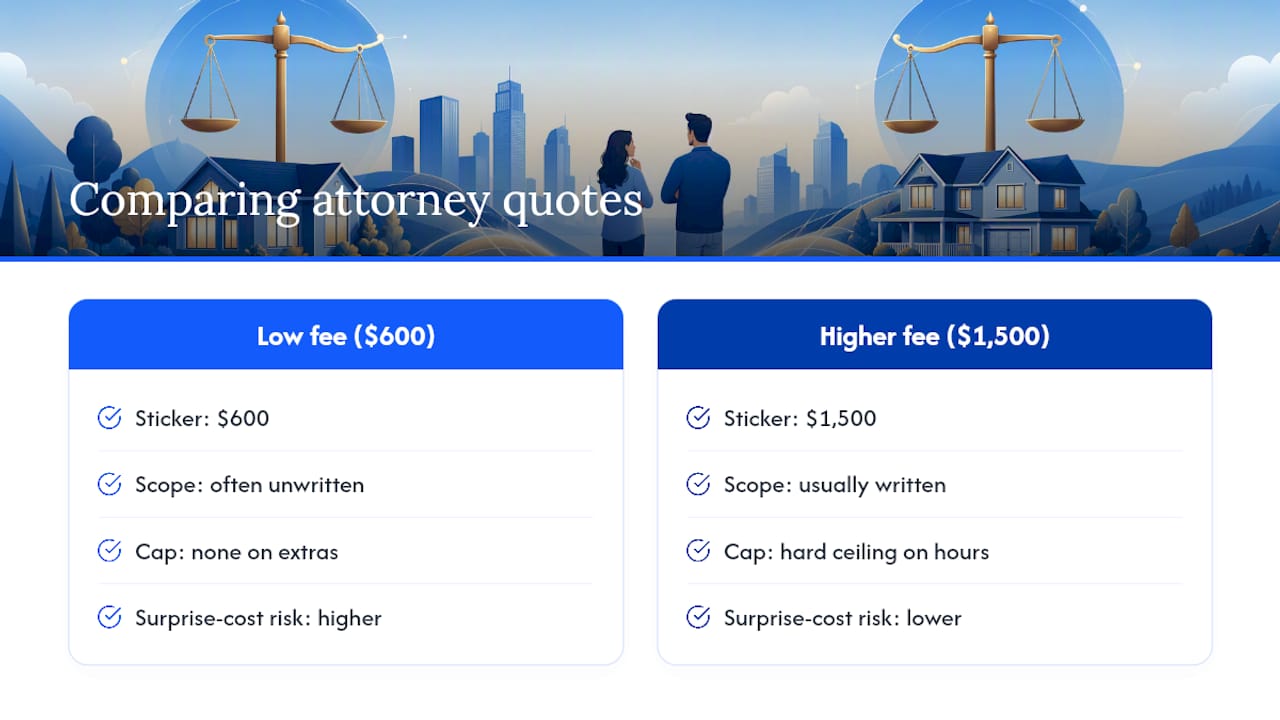
Conventional advice tells you to “shop around,” which is true but incomplete. Shopping around only works if you know what to compare. A $600 flat fee with no cap on extras can end up costing more than a $1,500 quote with a written scope and a hard ceiling on hourly work. The engagement letter matters more than the sticker price.
Prioritize this: get the scope in writing before you compare numbers. Everything else, the negotiation, the red flags, the state-by-state cost differences, only makes sense once you know exactly what each quote actually buys you.
— Service
Ready to Compare Vetted Local Professionals?
You’ve got the fee ranges and the questions to ask. The harder part is finding attorneys, title agents, and other closing-side professionals who are actually verified, not just the first name that shows up in a search. A local service platform is built for exactly that gap: search by service type and ZIP code, and you get verified business profiles you can compare side by side instead of cold-calling offices one at a time.

That same search-and-compare approach works for every professional involved in your closing, not just the attorney. Search Bestservicelocal by service and ZIP code to pull up verified providers near you and start comparing before you commit to anyone.
Sources
- Closing Attorney: Role, Costs, and State Requirements - LegalClarity
- 2026 Real Estate Lawyer Fees | Residential & Commercial Rates
- Engagement letters: what to include (Clio blog)
- How Much Is a Real Estate Attorney for Closing? (LawOfTheDay)