
$400–$8,000 Moving Company Cost: 2026 Benchmarks to Price Your Move
$400–$8,000 Moving Company Cost: 2026 Benchmarks to Price Your Move

Expect roughly $400 to $3,000 for a local move and $2,000 to $8,000 for a long-distance move, with the final number driven by distance, home size, service level, and timing. A studio apartment across town lands near the bottom of the typical cost range; a larger home moving a longer distance lands near the top. The fastest way to narrow that spread into a real number is the estimating method covered below.
TL;DR:
- Long-distance moves generally cost between $4,000 and $8,000, depending mainly on weight and mileage, with larger homes and longer distances increasing the total.
- Local moves are billed hourly, typically costing $80 to $150 per hour for a two-person crew, with costs rising if stairs, long carries, or additional services are involved.
- Decluttering before your move can significantly reduce costs by decreasing weight or volume, especially for long-distance relocations where weight directly impacts price.
- Moving during off-peak seasons (winter or mid-week) and requesting itemized, binding estimates can save 20-30% on total costs, especially for simple, short-distance moves.
Table of Contents
- How Much Does a Moving Company Cost, and What Sets the Price?
- What’s a Typical Moving Cost by Home Size?
- How Do Movers Calculate Your Bill?
- What Extra Fees Should You Expect on a Moving Quote?
- How to Estimate Your Move: A Step-by-Step Checklist
- What’s the Best Way to Lower Your Moving Bill?
- Does the Time of Year Really Change Moving Rates?
- Finding the Right Mover Without Guessing on Price
- Where These Numbers Come From
- Is Hiring Full-Service Movers Actually Worth the Cost?
- Sources
- FAQ
How Much Does a Moving Company Cost, and What Sets the Price?
Moving companies price local jobs and long-distance jobs on completely different systems, and confusing the two is the fastest way to misread a quote. Local moves are billed hourly. Long-distance moves are billed by weight and mileage. Once you know which model applies to your move, every other number on the estimate starts making sense.
Local moves (typically under 50 to 100 miles, within the same metro area) run on an hourly clock. You pay for the crew’s time, from arrival in the final box off the truck, plus a truck fee. Long-distance moves (interstate or cross-country) get priced by how much your stuff weighs and how far it travels, closer to how freight shipping works.
Within either category, you’re also choosing a service tier, and that choice moves the price more than almost anything else:
- DIY truck rental: You drive, you load, you unload. Truck rental plus fuel typically runs $150 to $500 for a local move, or several hundred to $2,000+ for a one-way long-distance rental depending on mileage.
- Labor-only movers: You rent the truck, they load and unload. Usually $80 to $150 per hour for a two-person crew, which keeps costs down while removing the heavy lifting.
- Full-service moving: Movers pack (optionally), load, drive, and unload. This is the standard option most people picture, and it’s where the bulk of quotes in this article fall.
- White-glove or premium service: Full packing, disassembly and reassembly of furniture, and sometimes storage in transit. This tier can run 20% to 50% above standard full-service pricing.
Truck rental sits at 40% to 60% cheaper than full-service for a comparable move, according to MoveSmart’s 2026 cost database, but that savings comes with real tradeoffs: your time, your back, and your liability if something breaks. A labor-only crew typically runs $80 to $150 per hour for two movers, which is a reasonable middle ground if you already own or can rent a truck but don’t want to load it yourself.
Whether you get a fixed price or a range up front depends on the tier and the mover. Hourly local jobs almost always get quoted as a range, since nobody can predict traffic or how fast your specific boxes will load. Long-distance moves, by contrast, are often quoted with a binding or binding-not-to-exceed estimate once a mover has your inventory in hand, because the weight and mileage math is more predictable than an open-ended hourly clock.
What’s a Typical Moving Cost by Home Size?
Home size is the single biggest lever after distance. A studio and a five-bedroom house aren’t just different in volume. They’re different in crew size, truck count, and hours on the clock, and that compounds fast once you add mileage.
The table below reflects national benchmark ranges. Your metro area, building access (stairs, elevators, parking), and the specific movers you call will shift these numbers up or down.
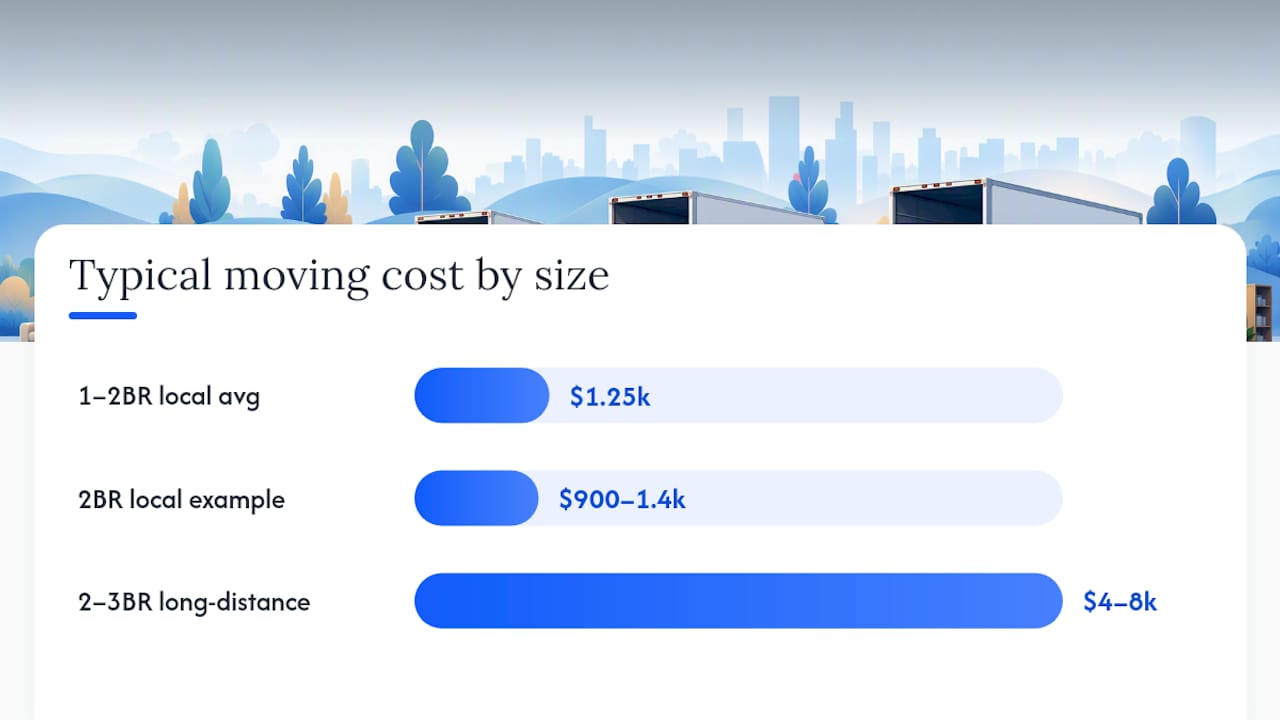
The national average for a local full-service move sits close to $1,250, which usually covers a one- or two-bedroom home with a standard two- to three-person crew working four to six hours. That number climbs fast once you add a third bedroom’s worth of furniture or a flight of stairs at either end.
Long-distance pricing tells a different story because weight, not room count, is the real unit of measurement. A typical two- to three-bedroom household weighs somewhere between 5,000 and 9,000 pounds. Full-service long-distance moves for that size home commonly land between $4,000 and $8,000, depending on how far the truck has to drive and how the carrier structures its per-hundredweight rate.
If you want a rougher but faster way to size your move, convert rooms to weight using this rule of thumb: a sparsely furnished bedroom runs about 1,000 to 1,500 pounds, a fully furnished bedroom with a bed, dresser, and closet contents runs closer to 2,000 to 2,500 pounds, and a living room with standard furniture adds another 1,500 to 2,000 pounds. Add those up, and you get a weight estimate close enough to sanity check any quote a mover hands you.
A quick real-world example: a two-bedroom apartment moving 30 miles across a metro area, with a standard crew of three, no stairs, and no packing service, typically lands around $900 to $1,400 total, which is close to the midpoint of the 2BR local range above.
How Do Movers Calculate Your Bill?
Local movers build their price from a handful of components you can actually itemize on a quote. Long-distance carriers build theirs from an entirely different formula involving a truck scale.
For local hourly billing, expect these line items:
- Hourly rate: Most local movers charge $80 to $150 per hour for a two-person crew; add roughly $30 to $50 per hour for each additional mover.
- Minimum hours: Many companies require a 2 to 4 hour minimum, even if your move takes less time.
- Truck fee: A flat charge, often $75 to $150, covering fuel and vehicle wear separate from labor.
- Fuel surcharge: Some movers tack on a percentage (often 5% to 10%) rather than folding it into the truck fee.
- Travel time: A number of companies bill a set amount, often 30 to 60 minutes, for the crew’s drive from their depot to your door.
For interstate long-distance pricing, the math changes completely. Carriers weigh your loaded truck at a certified scale, then weigh it again empty; the difference is your shipment’s billable weight. That weight gets multiplied by a per-hundredweight (per-cwt) rate, then combined with a mileage charge based on the distance between origin and destination. This is why decluttering before an interstate move saves real money: every 100 pounds you don’t ship is 100 pounds you don’t pay to haul across the country.
The most important paperwork distinction is binding versus non-binding estimates. A non-binding estimate is just that: an educated guess that can change once the movers see your actual inventory or weigh the truck, and you could end up owing more than quoted. A binding estimate, or binding-not-to-exceed estimate, locks in a price (or a price ceiling) in writing based on a detailed inventory, and it protects you from the final bill creeping upward on moving day. Whenever a long-distance move is involved, ask specifically for a binding estimate before you sign anything.
What Extra Fees Should You Expect on a Moving Quote?
The base hourly rate or weight-based price rarely tells the whole story. Add-on fees are where budgets quietly blow past estimates, and most of them are predictable if you know to ask about them ahead of time.
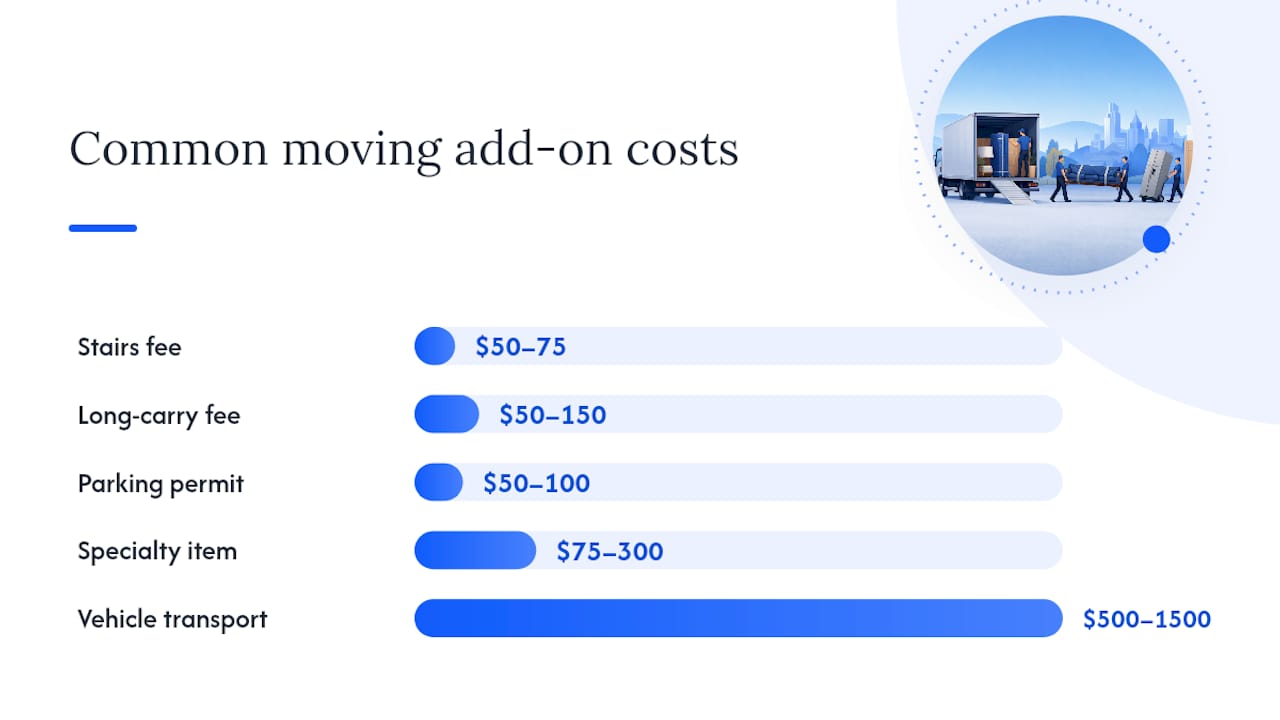
- Stairs: Often $50 to $75 per flight, charged at pickup, delivery, or both.
- Long carry: If the truck can’t park within a set distance (usually 75 to 100 feet) of your door, expect a long-carry fee, often $50 to $150.
- Elevator wait time: Buildings with slow or shared elevators can add 30 minutes to an hour of billed time.
- Parking permits: Dense cities may require a temporary no-parking permit for the truck, typically $50 to $100.
- Packing labor and materials: Partial packing services commonly add $350 to $600, while full-home packing can run $1,200 or more depending on square footage and fragile-item volume.
- Specialty items: Pianos, safes, pool tables, and gun cabinets usually carry a flat surcharge of $75 to $300 per item due to the extra crew and equipment needed.
- Vehicle transport: If you’re shipping a car alongside a long-distance move, auto transport typically costs $500 to $1,500 depending on distance and whether you choose open or enclosed transport.
Pro Tip: Ask every mover you quote to itemize stairs, long carry, and packing separately rather than folding them into a lump “extras” line. A mover who won’t break out the numbers is usually the one padding them.
Insurance, technically called “valuation” in the industry, deserves its own line of attention. The federal minimum coverage that comes standard with any interstate move values your goods at only about $0.60 per pound, which means a 50 pound television that gets damaged is worth roughly $30 in a claim. Full-value protection, which covers actual replacement cost, typically costs 1% to 5% of your total declared shipment value, and for anyone with furniture or electronics worth protecting, it’s usually worth the added line item.
How to Estimate Your Move: A Step-by-Step Checklist
A moving cost calculator gives you a starting range, not a final number. To turn that range into a budget you can actually trust, work through these steps in order:
- Build a room-by-room inventory. List major furniture, appliance count, and an estimate of boxes per room. This is the single input every calculator and every mover’s quote depends on most.
- Convert your inventory to weight or cubic footage. Use the room weight estimates from earlier in this article (roughly 1,000 to 2,500 pounds per bedroom, 1,500 to 2,000 for a living room) to get a working total.
- Run your numbers through two or three online calculators. Cross-referencing gives you a sanity check; no single tool captures every regional quirk.
- Request a virtual or in-home survey from at least three movers. A real person walking through your home (or your video call) catches items a spreadsheet misses, like a heavy antique dresser or an oddly shaped sectional.
- Ask each mover the same questions, so quotes are actually comparable: Is this binding or non-binding? What’s included in the hourly rate or per-cwt rate? What triggers an extra fee?
- Add a 10% to 20% buffer on top of whatever number you land on, to cover add-ons, seasonal swings, or last-minute inventory changes.
Calculator estimates tend to land within 15% to 25% of the final bill for a typical move, which is close enough to plan a budget but not close enough to skip getting written quotes. Treat the calculator as your first draft and the in-home or virtual survey as your final edit.
What’s the Best Way to Lower Your Moving Bill?
Cost control on a move comes down to three levers: when you move, how much you’re moving, and how much labor you’re paying for. Pull two or three of these and the savings compound.
- Move mid-week and mid-month. Movers charge less on Tuesdays and Wednesdays than weekends, and end-of-month dates (when most leases turn over) command a premium.
- Book in the off-season. Late fall through winter, outside of the holidays, tends to be the cheapest stretch of the year.
- Declutter before you get quotes, not after. For long-distance moves specifically, cutting weight is the single most effective way to cut cost, since every pound you don’t ship is a pound you don’t pay to haul.
- Consider labor-only or hybrid service. Renting your own truck or a portable container (like PODS or U-Pack) and hiring movers just to load and unload can cut total cost by 30% or more compared to full-service.
- Ask for a bundled quote. Some movers will fold stairs, long carry, and packing into one flat number if you ask directly, rather than itemizing surprises after the fact.
- Be suspicious of estimates far below the competition. A quote that’s dramatically cheaper than every other bid is a common setup for a hostage-load scam, where movers demand extra cash before unloading.
Does the Time of Year Really Change Moving Rates?
Yes, and the swing is bigger than most people expect. MoveSmart’s month-by-month price index shows February running 20% to 28% cheaper than the summer peak, while July and August carry a 30% to 40% premium over the cheapest months, driven by families moving around the school calendar and leases that overwhelmingly turn over in summer.
The seasonal swing, in dollars: A move priced at $2,500 in February could realistically run $3,250 to $3,500 for the identical job in July, purely from calendar timing.
Within any given month, the same logic applies at a smaller scale. Weekends and the last few days of the month see the highest demand, since that’s when most leases end and most people are off work. If your schedule has any flexibility, booking a mid-week date in the first half of a month, ideally outside of June through August, is the single easiest way to shave real money off your quote without changing a single thing about your inventory.
For booking lead time, aim for four to six weeks out on a local move and six to eight weeks out on an interstate move. Peak season (May through September) can tighten availability enough that popular dates book solid two to three months in advance.
Finding the Right Mover Without Guessing on Price
Getting multiple comparable quotes is the entire game here, and that’s exactly the friction point where most moving budgets go sideways. People call one company, get one number, and either panic at the price or accept it without knowing whether it’s fair.
Bestservicelocal lets you search local service providers, including moving companies, by ZIP code and see verified business profiles side by side instead of hunting through scattered review sites. Because every profile is tied to a specific service area, you’re comparing movers who actually operate in your neighborhood rather than a call center reading you a national average.
When you’re using the platform to shop movers, filter for the details that actually affect price: crew size offered, whether the company provides binding estimates, and whether packing and specialty-item handling are listed as in-house services or farmed out to a third party. Comparing three verified profiles side by side gives you the same leverage as the “get three quotes” advice every consumer guide repeats, minus the hour spent tracking down phone numbers.
Search Bestservicelocal by your ZIP code before you commit to the first quote you get. A five-minute comparison now can be the difference between a $1,200 move and an $1,800 one for the identical job.
Where These Numbers Come From
The pricing ranges throughout this article draw primarily on the MoveSmart 2026 Moving Cost Database, a large-sample dataset covering 127,432 verified moves, which is also the source of the seasonal price index and the home-size benchmark ranges. Lugg’s 2026 moving cost guide supplied the long-distance pricing breakdowns, insurance percentages, and specialty-service figures like auto transport. Move.org’s moving cost calculator informed the estimating checklist and the guidance on calculator accuracy and booking timing.
If you want to run your own numbers, start with a calculator from one of these sources, then follow it with an in-home or virtual survey from at least two movers before you commit to a date.
Is Hiring Full-Service Movers Actually Worth the Cost?
Full-service movers earn their price when your move involves stairs, a tight timeline, heavy furniture, or a long haul where your time has real value. Paying $2,000 to save two vacation days and a weekend of muscle strain is a fair trade for a lot of people, and it’s the calculation that full-service pricing is built around.
The math flips for a simple, short, local move, and sometimes upgrading your garage floor with an epoxy coating is a smart home improvement to consider after you settle in. A studio or one-bedroom apartment with no stairs and a short drive is exactly the scenario where a rented truck or a labor-only crew makes more financial sense than paying full hourly rates for a job that doesn’t need a full crew’s worth of expertise. The honest advice isn’t “always hire movers” or “always DIY.” It’s to match the service tier to the complexity of the specific move in front of you, and to get that match right before you start comparing dollar figures between quotes.
— Service
Sources
- The Complete 2026 Moving Cost Database: Real Rates, Regional Variations & Hidden Multipliers | MoveSmart Blog
- How Much Does It Cost to Move a House? (2026 Guide) | Lugg
- Move
FAQ
What Is the Average Cost of a Moving Company?
A local move typically costs $400 to $3,000, while a long-distance move typically runs $2,000 to $8,000, with home size, distance, and service tier determining where you land in that range.
How Much Do Movers Charge Per Hour?
Most local movers charge $80 to $150 per hour for a two-person crew, with additional movers adding roughly $30 to $50 per hour each.
Is It Cheaper to Move on a Weekday?
Yes. Moving mid-week and outside the end-of-month rush typically costs less than weekend or month-end dates, since those are the highest-demand slots for movers.
Should I Get a Binding or Non-Binding Estimate?
A binding estimate locks in your price based on a detailed inventory and protects you from the bill increasing on moving day, which makes it the safer choice for any long-distance move.