
Directory Advertising for Small Businesses Using ZIP Code Search
Directory Advertising for Small Businesses Using ZIP Code Search

Yes, directory advertising still earns its place in a small business marketing budget, especially for anyone chasing local, high-intent customers. The first move costs nothing: claim and verify your Google Business Profile, then pick one niche or local directory where your exact customers are already searching. The rest of this guide covers how to choose the right directories, optimize what you put in them, and measure whether they’re actually sending you paying customers.
TL;DR:
- Listing consistency across all directories is crucial for local SEO and to prevent ranking suppression due to conflicting NAP data.
- Niche and hyperlocal directories with active reviews generate higher-quality, high-intent leads compared to general directories with broad audiences.
- Fully optimized profiles, including specific service descriptions, multiple photos, and prompt review responses, significantly outperform poorly maintained listings.
- Regular tracking of leads, conversions, and review activity helps determine whether paid promotions deliver a positive return on investment.
- Effective directory advertising combines a complete, optimized profile with modest targeted promotions, especially on platforms with verified search activity.
Table of Contents
- What Is Directory Advertising and Why Does It Matter?
- Which Types of Directories Should You Prioritize?
- What Benefits and Limits Should You Expect?
- How Do You Advertise in Directories: Paid vs. Organic?
- How Do You Optimize a Directory Listing for Conversions?
- How Do You Measure ROI From Directory Advertising?
- What Mistakes Should You Avoid in Directory Advertising?
- What Do Successful Directory Advertising Campaigns Look Like?
- How Does Directory Advertising Affect Local SEO?
- Why Local AI Page Built Its Discovery Platform Around ZIP Search
- Get Your Business Listed and Optimized on Local AI Page
- Sources
What Is Directory Advertising and Why Does It Matter?
Directory advertising means placing your business listing, and often a paid or featured version of it, inside a platform organized by category or location: think Yelp, industry-specific directories for contractors or salons, or ZIP-code search tools like Local AI Page. The format itself is old. What’s changed is how directories now function as searchable, structured databases that both people and AI tools pull answers from.
The behavior that makes this channel different from a typical display or social ad: someone browsing a directory has usually already decided they need a plumber, a gym, or a hair salon. They’re not being interrupted mid scroll. They typed “HVAC repair near me” or filtered by ZIP code because they want to hire someone this week. That’s a fundamentally warmer lead than a banner ad served to a cold audience.
Directory advertising has traditionally been cheaper than broad media specifically because it trades reach for relevance. You’re not paying to shout at everyone. You’re paying to be visible to the smaller group already in buying mode.
Directory advertising tends to outperform broad demand-generation channels when:
- Your service has a clear local search pattern (roofing, dental, auto repair, fitness studios)
- Customers compare multiple providers before contacting one
- Trust signals like reviews and verified contact info influence the decision more than brand awareness does
Which Types of Directories Should You Prioritize?
Not all directories deliver the same value, and treating them as interchangeable is where most small businesses waste money. General directories cast a wide net but dilute intent. Niche and hyperlocal directories cost you reach but concentrate it on people who already fit your customer profile.
Industry practitioners consistently find that niche and ZIP-based directories deliver higher-intent traffic than general ones, simply because the user has already filtered by service type or neighborhood before they ever see your listing. A general business directory listing a dry cleaner next to a law firm next to a landscaper doesn’t do that filtering for you.
When deciding where to invest time and money, weigh these directory categories:
- General directories (broad, high traffic, low intent per visitor): good for baseline citations, weak for conversion volume
- Niche or industry directories (roofing associations, salon booking platforms, auto repair networks): smaller audience, much higher purchase intent
- Local or hyperlocal directories (ZIP-code search tools, chamber of commerce sites, city guides): strongest fit for service-area businesses
- Vertical platforms (review-heavy sites tied to one industry, like home services or fitness): valuable when reviews drive the buying decision
A directory has genuine local demand when it shows real search volume by area, not just a database of scraped listings with no visible user activity. Check whether businesses in your category actually have reviews and recent activity on the platform before paying for a featured spot.
What Benefits and Limits Should You Expect?
Directory advertising earns its keep in a few specific ways: it puts you in front of people actively searching, it builds trust through reviews and consistent business information, and it costs far less than most paid media.
The SEO angle matters more than most owners realize. Keeping your Name, Address, and Phone number (NAP) identical across every directory acts as a trust signal to search engines, and inconsistent NAP data is one of the quieter reasons local rankings stall out.
One thing to keep in mind: directory traffic converts differently depending on the platform, so don’t judge a $30/month listing and a $30/month Google ad by the same expectations, they’re solving different problems at different stages of intent.
Realistic expectations before you commit budget:
- Discovery and click-to-call conversions tend to be strong for directories with local intent
- Maintenance takes real time: updating hours, photos, and responding to reviews isn’t a one-and-done task
- Directories with low traffic or stale listings rarely justify a paid upgrade, per industry pricing guidance
- If your business has no local competition or serves a purely online market, directory spend delivers less value
How Do You Advertise in Directories: Paid vs. Organic?
Most directories offer two tiers: a free, organic listing you claim once, and a paid or promoted placement that pushes you higher, adds visual weight, or unlocks features like booking links. Directories typically monetize through subscription fees, cost-per-click ad slots, or flat monthly placements, and pricing varies widely by vertical and by how much traffic the directory actually has.
Choosing where to spend comes down to three filters: relevance to your category, visible traffic or review activity, and whether the directory’s audience matches your service area. A directory with thousands of listings but no reviews and no traffic isn’t worth a paid upgrade regardless of price.
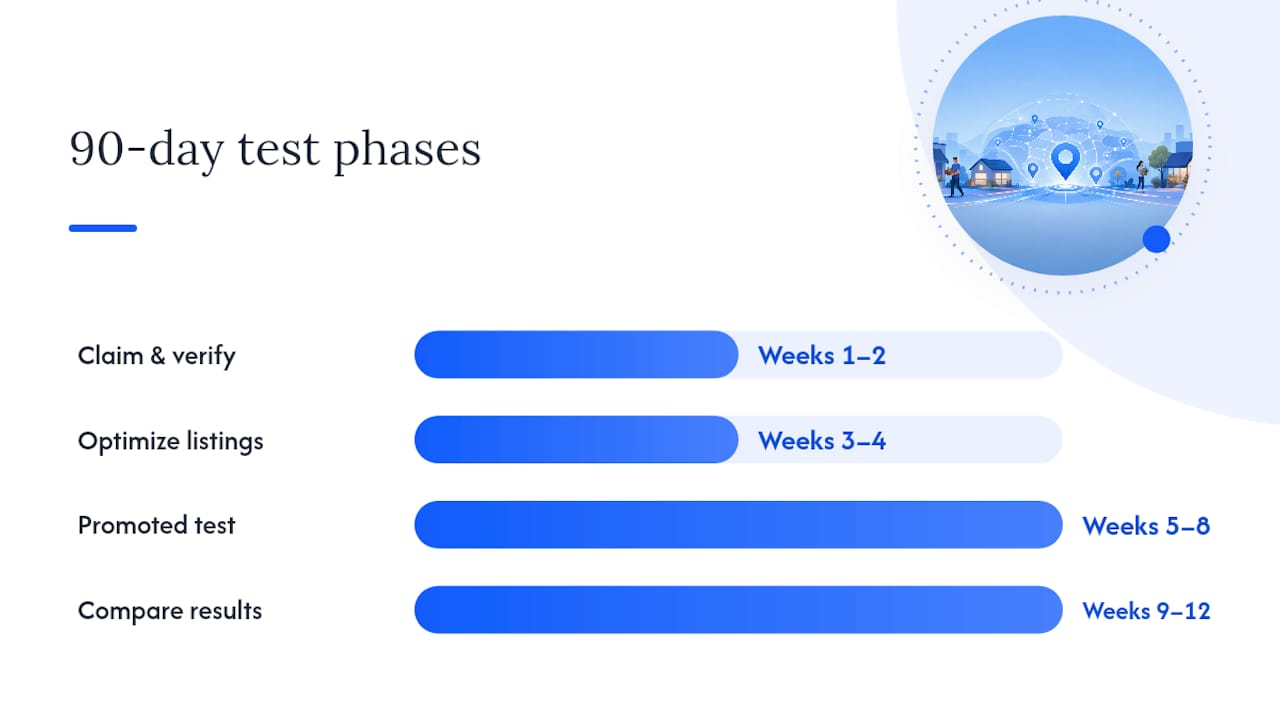
Here’s a 90-day plan to test directory advertising without overcommitting:
- Weeks 1 to 2: Claim and fully verify your Google Business Profile and two to three directories relevant to your industry, including at least one ZIP-based or local discovery platform.
- Weeks 3 to 4: Optimize each listing completely, correct category, full description, photos, and service list, before spending a dollar on promotion.
- Weeks 5 to 8: Run one small promoted placement on your single best-performing directory. Keep the spend modest and track every call or form submission separately from your organic listing.
- Weeks 9 to 12: Compare leads from the paid slot against your organic baseline. Validating a promoted listing against a control period is the only way to know if the upgrade actually paid for itself.
Pro Tip: Don’t promote a listing until it’s fully optimized. Paying to boost a thin, incomplete profile just gets more eyes on something that wasn’t going to convert anyway.
How Do You Optimize a Directory Listing for Conversions?
The listing itself does most of the work, or fails to. Get the fundamentals wrong and no amount of paid placement fixes it.
Start with NAP consistency and category accuracy: your business name, address, and phone number should match character for character across every directory, and you should select the most specific category available, not the broadest one. A roofer listed under “Home Services” loses to a competitor listed under “Roofing Contractor.”
From there, the elements that actually move conversion rates:
- A headline that states the specific service and area, not just your business name
- A description that leads with the customer’s problem and how you solve it, not company history
- At least five to ten photos showing real work, your team, or your location, listings with more photos consistently get more engagement
- A complete service list, FAQs, and attributes (licensed, insured, emergency availability) filled out fully, since thin listings underperform in visibility
- A steady review acquisition habit: ask every satisfied customer, and respond to every review, good or bad, within a few days
Pro Tip: Respond to negative reviews calmly and specifically. A thoughtful public response often does more to build trust with future customers than the negative review does to hurt you.
Treat your listing like a mini landing page. A completed, well-photographed profile reads as trustworthy at a glance, which is exactly the split-second judgment call a customer makes before clicking “call.”

How Do You Measure ROI From Directory Advertising?
Track conversions, not just clicks. The events that actually matter are phone calls, form submissions, booking requests, and direction requests, since a directory can generate plenty of views that never turn into contact.
Practical tracking methods that work at small business scale include dedicated tracking phone numbers for each directory, UTM-tagged links on any clickable listing field, and a simple spreadsheet where staff log “how did you hear about us” for every new inquiry. None of this requires enterprise software.
Watch three KPIs: cost-per-lead, lead quality (did the call turn into a job), and conversion rate from lead to customer. Run your validation test the same way you’d test any marketing spend, compare a period with a promoted listing against a baseline period without one, and let the incremental lead volume tell you whether the upgrade earned its cost.
| Metric | What it measures | How to collect it |
|---|---|---|
| Cost per lead | Total spend divided by number of inquiries | Divide directory fee by tracked calls/forms |
| Lead quality | Percentage of leads that become paying customers | Manual log or CRM tagging by source |
| Conversion rate | Leads that convert to booked jobs | Compare inquiries to closed jobs monthly |
| Call volume | Raw interest generated by the listing | Dedicated tracking number per directory |
Google Business Profile’s built-in insights data shows how customers found you, which is often the fastest way to see which directories are actually feeding your pipeline.
What Mistakes Should You Avoid in Directory Advertising?
The most expensive mistake is inconsistent NAP data. A business listed as “Smith Plumbing LLC” on one directory and “Smith Plumbing” on another confuses search engines and can quietly suppress your local rankings for months before anyone notices.
Second is paying for a promoted slot on a directory with no real traffic. Sales reps for low-quality directories often oversell placement value, and without visible reviews or search activity on the platform, you’re paying to be seen by almost no one.
Third: setting a listing up once and never touching it again. Stale hours, outdated photos, and unanswered reviews all signal neglect to a customer deciding between you and a competitor.
Fourth, and easy to overlook: choosing breadth over relevance. Ten mediocre general directory listings rarely outperform two or three well-optimized niche or local ones. Spreading your attention thin means none of your listings get the photos, descriptions, and review responses that actually drive conversions.
Finally, skipping measurement entirely. Businesses that never track which directory sent a call end up renewing underperforming subscriptions out of habit, while the directory that’s actually converting gets no additional investment.
What Do Successful Directory Advertising Campaigns Look Like?
The pattern behind directories that actually work for small businesses is almost always the same: a fully completed profile, a narrow category selection, and a steady stream of recent reviews, paired with a modest promoted placement layered on top rather than a paid slot propping up a bare-bones listing.
A local HVAC company that claims its listing, fills in service area boundaries down to specific ZIP codes, uploads real job photos, and answers every review within 48 hours will typically out-convert a competitor with a generic, unattended listing, even if that competitor pays more for a featured spot. The optimization does more heavy lifting than the ad spend does.
The same logic applies across categories, from a boutique fitness studio using ZIP-code discovery pages to reach nearby residents, to a roofing contractor whose fully built-out profile becomes the first result a homeowner clicks after a storm. In each case, the businesses that treat their directory presence as a maintained asset, not a one-time task, are the ones pulling steady lead flow months later.
How Does Directory Advertising Affect Local SEO?
Directory listings feed directly into local search rankings, mostly through citation consistency and link signals. Every directory that lists your business with matching NAP data reinforces to Google and other search engines that your business is legitimate and located where you claim to be.
Beyond citations, directories with strong domain authority pass some SEO value through backlinks to your website, though the bigger effect is usually indirect: more visibility across multiple platforms means more chances for a customer to find and click through to you, which in turn generates the engagement signals search engines reward.
Reviews compound this effect. A directory listing with a steady flow of recent, detailed reviews doesn’t just convert better on that platform, it often shows up in the review snippets and rich results that Google surfaces directly in search. For a small business without the budget for a dedicated SEO campaign, a well-maintained set of directory listings is one of the more reliable ways to build that local search foundation over time.
Why Local AI Page Built Its Discovery Platform Around ZIP Search
We built Local AI Page around the belief that local discovery breaks down when listing data is inconsistent or incomplete, so ZIP-code search, verified business profiles, and mapped service areas sit at the core of the platform. A structured, AI-friendly profile format means the details customers actually need, hours, service areas, direct contact info, stay accurate and easy to find.
Consistent, complete data doesn’t just help customers decide faster. It improves how a listing performs across search generally, since accuracy and structure are exactly what both people and algorithms reward.
— Local AI Page
Get Your Business Listed and Optimized on Local AI Page
Local AI Page gives you the exact playbook from this guide already built into the platform: claim your business, verify your service area by ZIP code, and build out a profile with photos, FAQs, and direct contact details, without piecing together a dozen separate directory accounts.
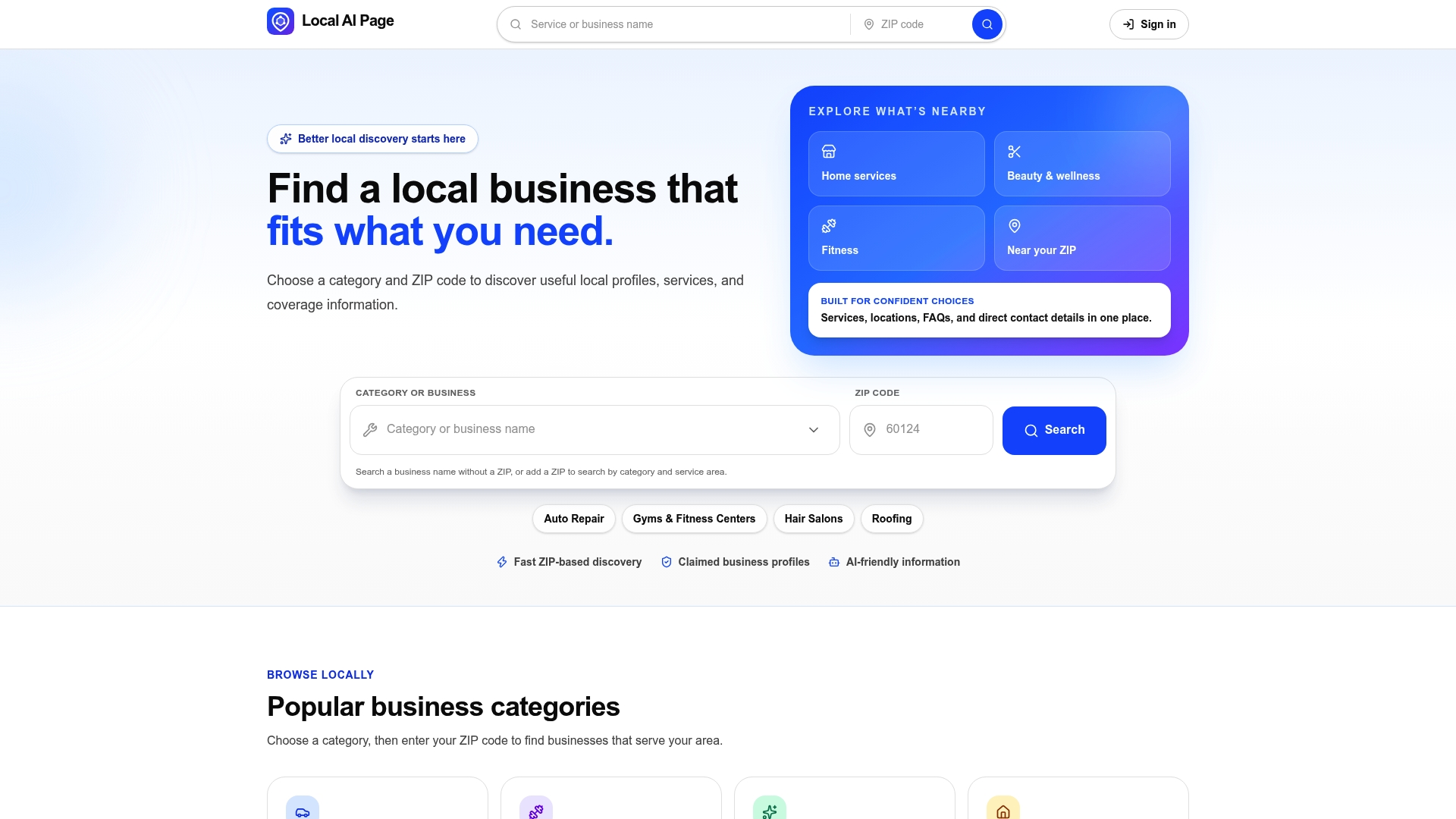
Getting started supports the same actions covered above: you can claim a free listing, enhance it with a complete service list and photos, or test a promoted placement to see how it performs against your organic baseline. Businesses that complete their profiles tend to see more accurate discovery and more direct customer contacts, since a fully built-out profile is what shows up when someone searches their ZIP code for exactly what you offer.
A short starter checklist you can hand off:
- Claim your business listing and confirm your service area
- Upload current photos and a complete service description
- Verify your listing appears correctly on your local ZIP page
Search local businesses by ZIP code to see how your category is represented in your area today, then claim your spot before a competitor does.
Sources
Google Business Profile for core listing setup, SBA’s local marketing guide for broader strategy, and directory monetization models for pricing context.
- Online Directory Business Model Explained - GeoDirectory
- Directory Advertising - Definition & Meaning | MBA Skool