
How to Choose an Electrician: Checks, Questions and Quotes
How to Choose an Electrician: Checks, Questions and Quotes
The right electrician holds a license that is active in your state, carries insurance you have seen on paper, has done your kind of job before, and puts the scope, price and permits in writing. Everything else is secondary. The hard part is finding several providers who actually serve your address, so you can compare them side by side. On Best Service Local you search by service type and ZIP code, so every electrician you look at works in your area, and you can compare profiles before you contact anyone.
This guide walks through the decision in the order you will face it: what kind of job you have, what to verify, how to judge experience, how to read a quote and which warning signs should end the conversation.
TL;DR
- Verify the license yourself with the state’s lookup tool. A number on a business card or ad proves nothing.
- Ask to see current insurance, including workers’ compensation if the electrician has employees.
- Match the electrician to the job: a panel upgrade, an old-wiring repair and an urgent outage call for different experience.
- Get at least three itemized written quotes and compare scope, not just the total.
- Walk away from door-to-door solicitors, cash-only demands, large up-front payments and anyone who asks you to pull the permit yourself.
Table of Contents
- Start by sizing the job
- Check the license before anything else
- Confirm insurance, then ask for the paper
- Judge experience against your specific job
- Codes change, so ask about them
- Compare written quotes the right way
- Warning signs that should end the conversation
- Find local electricians who serve your ZIP code
- FAQ
- Sources
Start by sizing the job
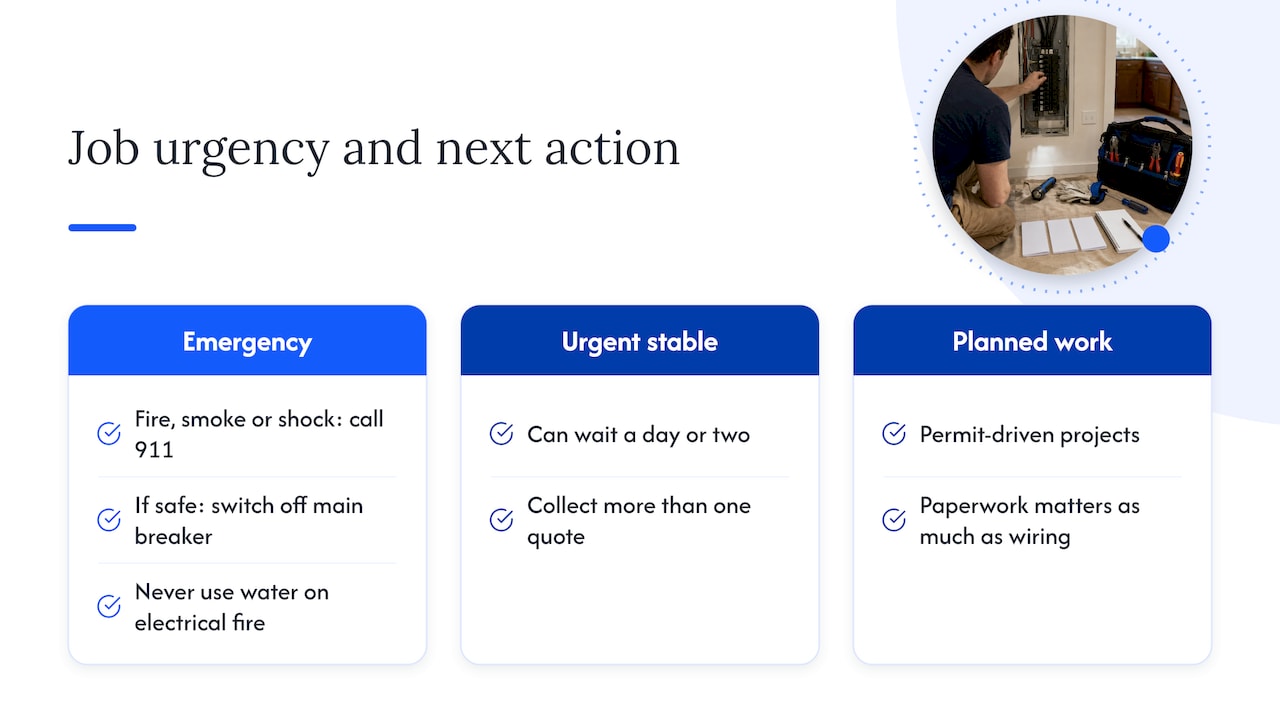
Before you call anyone, decide which of three situations you are in. It changes how fast you move and what you ask.
A true emergency. Burning smells, smoke, visible sparks, outlets or panels hot to the touch, water near wiring. If there is fire, smoke or a shock, call 911 first. If it is safe to reach the panel, switch off the main breaker, and never use water on an electrical fire. At this point you want the nearest provider who can come quickly, so the ZIP code search matters most. Our guide to emergency electrician rates, fees and night premiums explains what an after-hours call usually costs, so a surprise bill does not add to the stress.
An urgent but stable problem. A breaker that trips once and holds, or a single dead outlet with no heat or smell, can wait a day or two. That gives you time to do the checks below and collect more than one quote.
Planned work. Panel upgrades, new circuits, EV charger installs, remodel wiring and whole-house rewiring. These are permit-driven projects, and the quality of the paperwork matters as much as the quality of the wiring. Budgeting for them is covered in our electrical panel upgrade cost guide.
If the damage came from weather, such as a downed line or a flooded basement, read our storm damage restoration guide first for the safe order of steps.
Check the license before anything else
Electrical work is licensed at the state level in most of the country, sometimes with extra city or county registration. The details differ by state, which is why the first rule is to check with your own state, not a generic checklist.
What the official guidance agrees on:
- Ask for a copy and confirm it with the issuer. FEMA’s contractor checklist says to ask for a copy of the license, check the expiration date and contact the issuing authority to confirm it is in good standing.
- A license number on an ad is not proof. Virginia’s licensing agency notes that a license number in an advertisement or on a business card does not necessarily mean the license is valid. The same document says licensed contractors are required for work valued at $1,000 or more in Virginia and that hiring one makes you eligible for the state’s Contractor Transaction Recovery Fund if the work goes wrong.
- Look at the history. Washington’s Department of Labor & Industries tells homeowners to use its verification tool to confirm an active license, bonding and insurance, and to review the license history for earlier lawsuits or violations.
- Match the license to the person and the scope. Connecticut’s consumer protection department stresses that a credential must match the individual’s identity and the scope of the work, and that you can check any credential’s status on the state’s public portal. The same report describes a 2024 revocation of an electrical contractor’s license after the holder let unqualified people work under it. So ask who will actually be in your home, not only whose name is on the truck.
Texas shows how specific the rules can be. Anyone offering electrical contracting there must be licensed by the state, and the consumer guide says bids should include the license number and that you should verify both the contractor’s and the master electrician’s licenses through the state’s license search. The state’s occupations code also requires an electrical contractor to be a licensed master electrician or employ one.
For a state-by-state walkthrough, see our guide on how to verify a contractor license in your state. For the wider screening picture, contractor background checks covers what else is worth confirming.
Master, journeyman, apprentice: what the titles mean
You will hear these terms on the phone, so here is the plain version. A journeyman electrician has finished an apprenticeship and can install wiring and equipment. A master electrician has passed a standardized exam after additional experience and can plan, design and supervise the work. This Old House describes master electricians as having passed a standardized test with at least two years of experience, able to design and maintain systems, while journeymen cannot design systems. The BBB adds that journeymen follow a master’s plans and work under permits assigned to the master.
In practice: for a small repair, a journeyman sent by a licensed company is normal. For anything that involves new circuit layout, a service change or a load calculation, make sure a master electrician is responsible for the job.
Confirm insurance, then ask for the paper
A license says the electrician is qualified. Insurance says who pays if something goes wrong. These are separate checks.
- Ask to see the policy, not just hear about it. The BBB advises asking to see a copy of the electrician’s insurance policy and making sure it is current. It also points out that a policy meeting state minimums may not be enough to cover your house if a fire starts, so ask what the limits are.
- Ask about workers’ compensation. If the electrician has employees, the BBB says they should also carry employer coverage. Without it, an injured worker on your property can become your problem. Texas requires electrical contractors to maintain workers’ compensation for employees through an authorized insurer or self-insurance, per the occupations code linked above.
- Check bonding where your state requires it. Oklahoma, for example, has required a $5,000 license bond and a general liability policy for electrical contractors, with workers’ compensation proof added in 2026 rules, according to a summary of the state’s rule changes. Your state may differ, so confirm on its licensing board’s site.
Judge experience against your specific job
A good electrician for one job can be the wrong one for another. The BBB gives a clear example: a company that specializes in large commercial jobs may not be a good fit to fix a flickering kitchen light. Residential work, commercial work and service calls are different trades in daily practice.
Use these questions to test fit:
- How many jobs like mine have you done in the last year?
- Will you pull the permit and schedule the inspection? (The right answer is yes.)
- Who will be on site, and are they your employees?
- How do you handle surprises once the wall is open?
Older homes deserve extra care. This Old House’s electrician explains that spotting old wiring, such as cable with no ground inside the wire, is the first clue to what an older house needs, and that some homes need replacement rather than patch repairs. If your house is decades old, say so up front and ask whether the electrician has worked on that vintage of wiring.
On permits, FEMA offers a useful local-experience test: ask how many building permits the contractor has obtained in your jurisdiction in the last two years. It also notes that a contractor who asks you to get the permit yourself is likely unlicensed or unqualified. Having the contractor handle permits and inspections puts an independent party on your side to confirm the work meets code.
Reviews and referrals
Reviews are useful for patterns: punctuality, communication, cleanup, how problems were handled. Read the recent ones and the lowest-rated ones, and look at how the business responded. Referrals from neighbors, friends or your general contractor are a good starting list. Reviews and referrals tell you about behavior. They never replace the license and insurance checks above.
Codes change, so ask about them
Electricians install to the National Electrical Code, which is updated every three years and adopted state by state on different schedules. Minnesota’s board adopted the 2026 edition effective August 17, 2026: permits filed before that date follow the 2023 code, and permits filed after follow the 2026 code. Washington has adopted 2026 amendments that take effect December 31, 2026, and its recent rulemaking changed requirements for installing electric vehicle charging equipment.
You do not need to learn the code. You need an electrician who knows which edition applies where you live and can tell you so when you ask. For an EV charger, a panel upgrade or a remodel, that one question separates people who keep up from people who do not.
Compare written quotes the right way
Get at least three. This Old House recommends quotes from at least three electricians to gauge fair market rates and spot outliers. The cheapest number is not the goal. A complete quote is.
Florida’s licensing brochure says a written estimate should include the work to be done, the materials, the completion date and the total cost. A contract should add the contractor’s name, street address, phone number and license number, a precise description of the work, a completion date that includes cleanup, and the warranty length, terms and recourse.
Here is a simple way to line up three bids:
| What to compare | Why it matters |
|---|---|
| License number and holder’s name | Confirms who is legally responsible |
| Scope of work, line by line | One bid may include items another leaves out |
| Materials and equipment ratings | Panel size, breaker type and wire gauge change both price and safety |
| Permits and inspection | Who pulls them, and whether the price includes fees |
| Start and completion dates | Includes cleanup |
| Payment schedule | Tied to progress, not a large deposit |
| Warranty terms | Length, what is covered, who to call |
A bid that looks low often leaves out permits, testing or cleanup. If one number is far from the other two, ask what is missing before you assume it is a bargain. Our explainer on estimate vs. quote shows what each document commits the contractor to, and the electrician cost guide gives hourly rates and typical job prices so you can tell whether a number is in range.
Payment terms
Texas’s consumer guide advises that you not pay for a job in full before it is complete, including the closing of city permits with a final inspection, as stated in its electrical consumer protection guide. Keep your final payment tied to the passed inspection.
Warning signs that should end the conversation
Florida’s regulator lists the classic signs of an unlicensed operator in its licensing brochure:
- Unmarked vehicles and door-to-door solicitation
- A post office box instead of a street address
- Demands for large up-front payments or cash
- Pressure on you to get the building permits yourself
- Claims of being the fastest or the cheapest
Add two more from the guidance above: a license you cannot confirm with the issuing authority, and an insurance policy that is “on file somewhere” but never produced. Any one of these is enough to move on to the next provider on your list.
Storm seasons raise the risk. FEMA’s checklist notes that after disasters, outside contractors unfamiliar with local codes often arrive. A contractor with a local permit history is the safer choice.
Find local electricians who serve your ZIP code
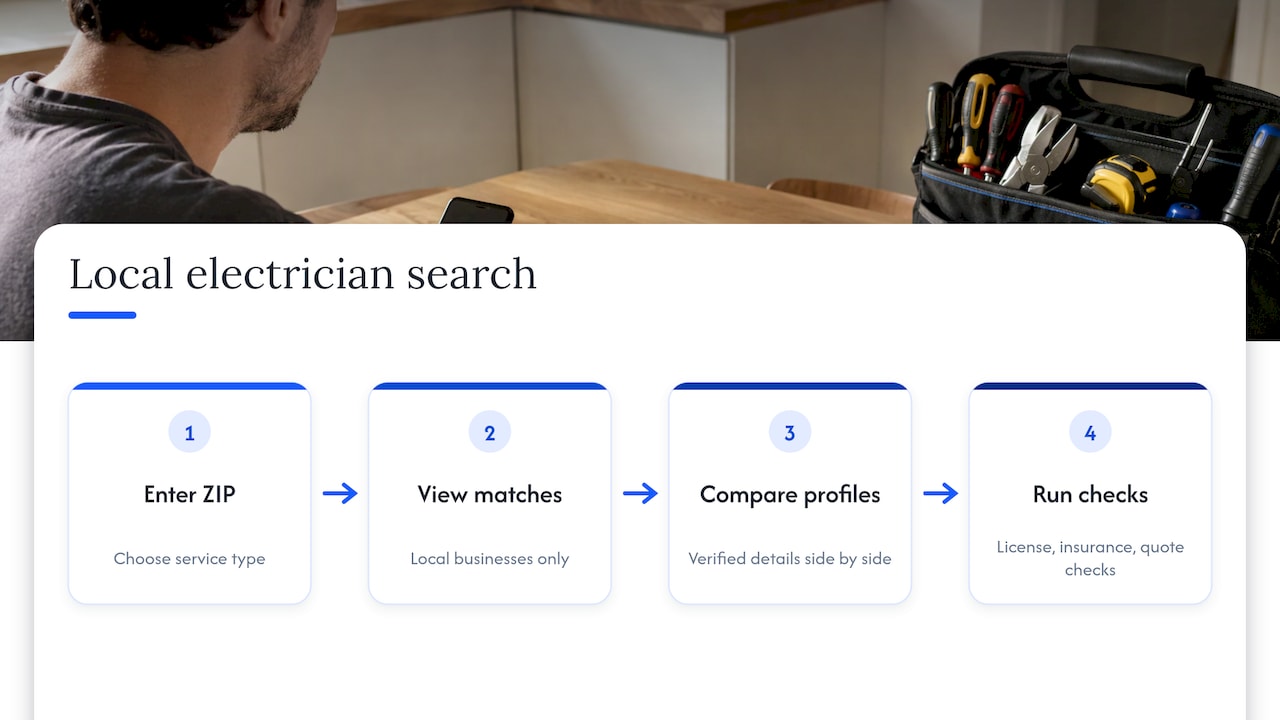
The checks above take time when you start from a blank search page. On Best Service Local, you pick the service type and enter your ZIP code, and you see businesses that operate in your area. Each business has a profile with verified details, and you can compare multiple providers side by side before reaching out. Browsing and searching are free for consumers.
That comparison step is where the work above gets easier: put three profiles next to each other, then run the license and insurance checks on the ones you like. If you want to see what a profile looks like, SAFE Electrical, a residential electrician in Crestwood, IL is one example. When you are ready, search local businesses by service and ZIP code.

Property managers and business owners who need fast maintenance coverage can use the same search to build a short list of providers in each building’s ZIP code before an outage happens.
Our view: local coverage is the first filter
We built Best Service Local around a simple idea: a qualified electrician is only useful if they actually work where you live. That is why we match by service type and ZIP code, so the businesses you see operate in your area.
The second filter is information. A profile with verified business details and clear services lets you compare providers on the same terms, instead of on whoever answered the phone first. For an electrician, that means you can line up several options, then apply the license, insurance and written-quote checks in this guide with confidence.
Hiring under pressure is when mistakes happen. We think the best moment to find your electrician is before the breaker panel fails, and the easiest way is to compare local providers side by side and keep a short list.
Service
FAQ
How do I choose an electrician for a small repair?
Confirm the license with your state’s lookup tool, ask to see current insurance, and get a written price before work starts. For a simple fix, a licensed company sending a journeyman is normal. Check that permits are handled by the electrician if your local rules require them.
What is the difference between a master electrician and a journeyman?
A journeyman can install wiring and equipment but works from a master’s plans. A master has passed a higher exam with more experience and can design systems and supervise others. For layout changes, panel work or a whole-house project, make sure a master is responsible for the job.
How many quotes should I get?
Three is a good minimum. It helps you see the normal price range and spot an outlier that is too high or suspiciously low. Compare the scope, materials, permits, schedule and warranty, not only the total.
How do I find the best local electricians near me?
Start with providers that serve your exact ZIP code, then narrow the list by services offered, profile details and responsiveness. On Best Service Local you can search by service and ZIP code and compare profiles side by side. Then verify the license and insurance of your top picks.
Should I pay a deposit?
Keep any up-front payment small and tied to the written agreement, and avoid cash-only terms. Official consumer guidance advises against paying in full before the work is complete and any permits have been closed with a final inspection.
Sources
- FEMA: Checklist to Ask Your General Contractor
- Virginia DPOR: Before You Hire A Contractor
- Washington L&I: Hiring a Contractor
- FOX 61: Verify credentials and only hire licensed contractors
- Texas TDLR: Electrical consumer protection guide
- Texas Occupations Code Chapter 1305
- This Old House: How to Find an Electrician
- BBB Tip: Hiring an electrician
- Oklahoma electrical rule changes summary
- Minnesota DLI: Electrical codes and standards
- Washington L&I: Electrical Laws, Rules & Policies
- Florida DBPR: Hire Only Licensed Electrical and Alarm System Contractors