
Bonded and Insured Meaning: What Each Protects You From
Bonded and Insured Meaning: What Each Protects You From

When a contractor says they are “bonded and insured,” they are describing two separate safety nets. Being insured means the company bought business insurance, such as general liability, to pay for covered accidents and damage. Being bonded means it bought a surety bond, a financial guarantee that pays the customer if the company breaks the rules or fails to meet its obligations. Forbes Advisor draws the same line: insurance compensates the business for covered losses, while a bond pays the client.
The words only help you if you can confirm them. On Best Service Local you can search by service type and ZIP code, open business profiles and compare providers side by side, so you can start from local companies and then run the checks below on each one.
TL;DR
- Insured means the company holds insurance policies, usually general liability, that pay for covered injury or property damage tied to its work.
- Bonded means the company has a surety bond that protects you, the customer, and the surety can pay a valid claim.
- A bond protects the customer; insurance protects the policyholder. Ideally you want both, plus a license where your state requires one.
- Ask for a certificate of insurance, then confirm it with the insurer. Check the license and bond status on your state’s licensing board lookup.
- If a company subcontracts the work, ask to see the subcontractor’s coverage too.
Table of Contents
- What “insured” means
- What “bonded” means
- Bonded vs. insured: the differences that matter to you
- Worked example: a $12,000 kitchen remodel
- How to confirm a contractor is bonded and insured
- Quick questions to ask on the phone
- Who this matters to beyond homeowners
- Find local providers to check
- Our perspective
- FAQ
- Sources
What “insured” means
A contractor who is insured has bought one or more business insurance policies. The one most homeowners care about is general liability. According to McKnight Insurance, general liability usually covers three things: damage to someone else’s property, injury to someone else’s body, and “completed operations,” meaning claims that arise after the job is finished.
The Maryland Insurance Administration describes commercial general liability as protection against claims for bodily injury, property damage and injury to reputation. The insurer defends covered claims and pays up to the policy maximum, and the policyholder is responsible for anything above that limit.
That last point matters when you read a certificate. The number printed on it is the ceiling. A common commercial benchmark is $1 million per occurrence, and FilterBuy’s verification guide notes that a $300,000 policy is thin protection against something like a whole-house fire.

What general liability does not cover
General liability is not a single policy that covers everything. McKnight lists what sits outside it: the contractor’s own employees (that is workers’ compensation), vehicles (commercial auto) and tools (inland marine). The Maryland Insurance Administration likewise says workplace injuries to workers need a separate workers’ compensation policy.
For you, the practical question is simple: if a worker gets hurt on your property, which policy responds? A contractor with workers’ compensation in place has an answer. Ask for both policies, not just one.
What “bonded” means
A bonded contractor has obtained a surety bond. Procore’s guide to contractor license bonds explains that a license bond guarantees the contractor will operate ethically and follow local licensing rules. The contractor is required to buy it but is not the one it protects: the bond protects the public, while general liability insurance protects the contractor.
The three parties in a bond
McKnight describes a surety bond as a three-party agreement:
- Principal: the contractor who buys the bond.
- Obligee: the customer, or the body requiring the bond.
- Surety: the bonding company that guarantees the promise.
If the contractor fails to complete a job, causes financial harm, or an employee steals, the surety pays a valid claim up to the bond limit and then seeks reimbursement from the contractor. CCIS Bonds adds that the contractor must repay the surety in full when a claim is proved valid, possibly including legal fees. That repayment duty is a strong reason for contractors to run their jobs properly.
License bonds and contract bonds
There are two kinds you will hear about.
License bonds are tied to the contractor’s license. Procore says a license bond “follows” the contractor from job to job and covers compliance failures such as unpaid taxes, late paperwork, fraud or misrepresentation, and unlicensed work. It does not generally cover workmanship or property damage, which is where insurance comes in.
Contract bonds (also called performance and payment bonds) guarantee a specific job is completed and that labor and materials are paid for. California’s contractor board says these typically cost 1 to 2 percent of the contract price, and they are most common on larger projects.

How big is a license bond?
The amount depends on the state. California’s Contractors State License Board states that a contractor must post a $25,000 surety bond to get a license. Homeowners, fraud victims, unpaid employees and employees owed fringe benefits may file claims if the contractor violates state license law, causes property damage or fails to pay workers.
The same board points out that the bond amount is a cap shared by everyone who files a claim, so it can fall short on a large project or when several people claim. That is the reason to read it as one layer of protection, alongside insurance, a written contract and a payment schedule you control. Rules differ widely by state, and some states require no bond for some trades, so look up your own state’s board before you assume.
Bonded vs. insured: the differences that matter to you
Procore’s comparison of bonds and insurance names three differences. Here they are in plain terms, with a fourth that comes from how surety works.
| Insured | Bonded | |
|---|---|---|
| Who is protected | The policyholder (the contractor) | The customer or project owner |
| Who pays after a claim | The insurer, with no repayment by the policyholder | The surety, which then recovers the money from the contractor |
| Control over the project | The insurer has none | A surety can take part in how a defaulted job is finished |
| Typical trigger | Accidents, injury, property damage | Broken contract terms, license violations, unpaid workers or suppliers |
The National Association of Surety Bond Producers adds that surety is built to prevent loss: the surety looks at the contractor’s financial strength and construction expertise before issuing a bond, so the premium also pays for that prequalification.
Is it better to be bonded or insured?
Neither replaces the other. Insurance answers “what happens if something gets damaged or someone is hurt.” A bond answers “what happens if the company breaks its obligations to me.” For a home project, the strongest position is a licensed contractor (where your state requires a license) who carries general liability, workers’ compensation if they have employees, and a bond where one applies.
Worked example: a $12,000 kitchen remodel
Suppose you hire a remodeler for a $12,000 kitchen job in a state that requires a license bond.
- A worker drops a heavy appliance and cracks your neighbor’s fence. That is third-party property damage, which general liability is built for.
- A different worker is injured on a ladder. That belongs to the contractor’s workers’ compensation, not general liability.
- The contractor takes your deposit, then violates licensing rules or leaves a supplier unpaid. That is the territory of a bond, within its limit and the claim process of your state.
- A pipe fitting installed last month fails and floods the floor after the job is done. That is a completed operations question under general liability.
One project, three different protections. Hearing “bonded and insured” without asking which policies and which limits tells you very little.
How to confirm a contractor is bonded and insured
Anyone can print “bonded and insured” on a truck. Verification takes about 15 minutes, and you can do it before you sign anything.
Step 1: Check the license
Start with your state’s contractor licensing board lookup. Many boards also show bond status on the same page. Our guide to verifying a contractor license in your state walks through the lookup, and if you are checking a mover rather than a builder, this explainer on verifying a license before paying shows how the same habit works in New England.
Step 2: Ask for a certificate of insurance
A certificate of insurance (COI) is a one-page summary of a company’s policies. Ask for it by name and read the policy types, limits and dates. Then take one more step: call the insurer or have the contractor’s agent send the certificate directly to you.
FilterBuy explains why. A certificate only confirms the policy was active on the day it was issued, and a policy can be canceled the day after. You can ask to be listed as the certificate holder so you are notified if coverage is canceled mid-project.
Step 3: Ask who does the work
If the company hires subcontractors, the subcontractor’s insurance is what is actually on your property, and your COI may cover only the general contractor. Ask whether employees or subcontractors will do the work, and request the subcontractor’s certificate too.
Step 4: Verify the bond itself
Get the bond number and the surety’s name, then check that the surety is authorized in your state. The National Association of Surety Bond Producers recommends contacting your state insurance department to confirm the surety is admitted where the project is located.
For federal work, the U.S. Department of the Treasury publishes a list of approved sureties (Circular 570). The surety’s name on the bond should match the licensed company’s name exactly: The Basic Bond Book warns that unlicensed entities have used names very close to legitimate sureties. The simplest confirmation is to call the surety directly.
Step 5: Put it in writing
Once the paperwork checks out, get the scope and price in writing. Our piece on estimate vs. quote explains what each document commits a contractor to, and the guide to contractor background checks covers the rest of what to verify before you hire.
Quick questions to ask on the phone
- Are you licensed in this state, and what is the license number?
- Which insurance policies do you carry, and what are the limits?
- Do you carry workers’ compensation for the crew who will be at my home?
- Are you bonded? What is the surety’s name and the bond number?
- Will your own employees do the work, or subcontractors?
- Can your insurance agent send the certificate to me directly?
A professional company answers these without hesitation. They are routine for anyone who runs a real business.
Who this matters to beyond homeowners
Property managers who call in emergency maintenance, such as a burst pipe or storm damage, face the same question under time pressure. It is easier to collect certificates and bond details when you are not in the middle of an emergency, so build a short list of vetted providers ahead of time. Our storm damage restoration guide covers the safe first steps.
Business owners reading this from the other side: your clients are asking the same questions. Having your license number, certificate and bond information ready is the quickest way to answer them.
Find local providers to check
Best Service Local lets you search home repair, fitness, automotive, pet, legal and many other categories by service type and ZIP code, so the businesses you see operate in your area. Each business has a profile with its details and contact options, and you can compare several providers side by side before you reach out. Browsing and searching are free for consumers.
To see examples of what a profile looks like, open G.R. General Contracting or Mr. Handyman. Then run the checks above on the ones you shortlist.
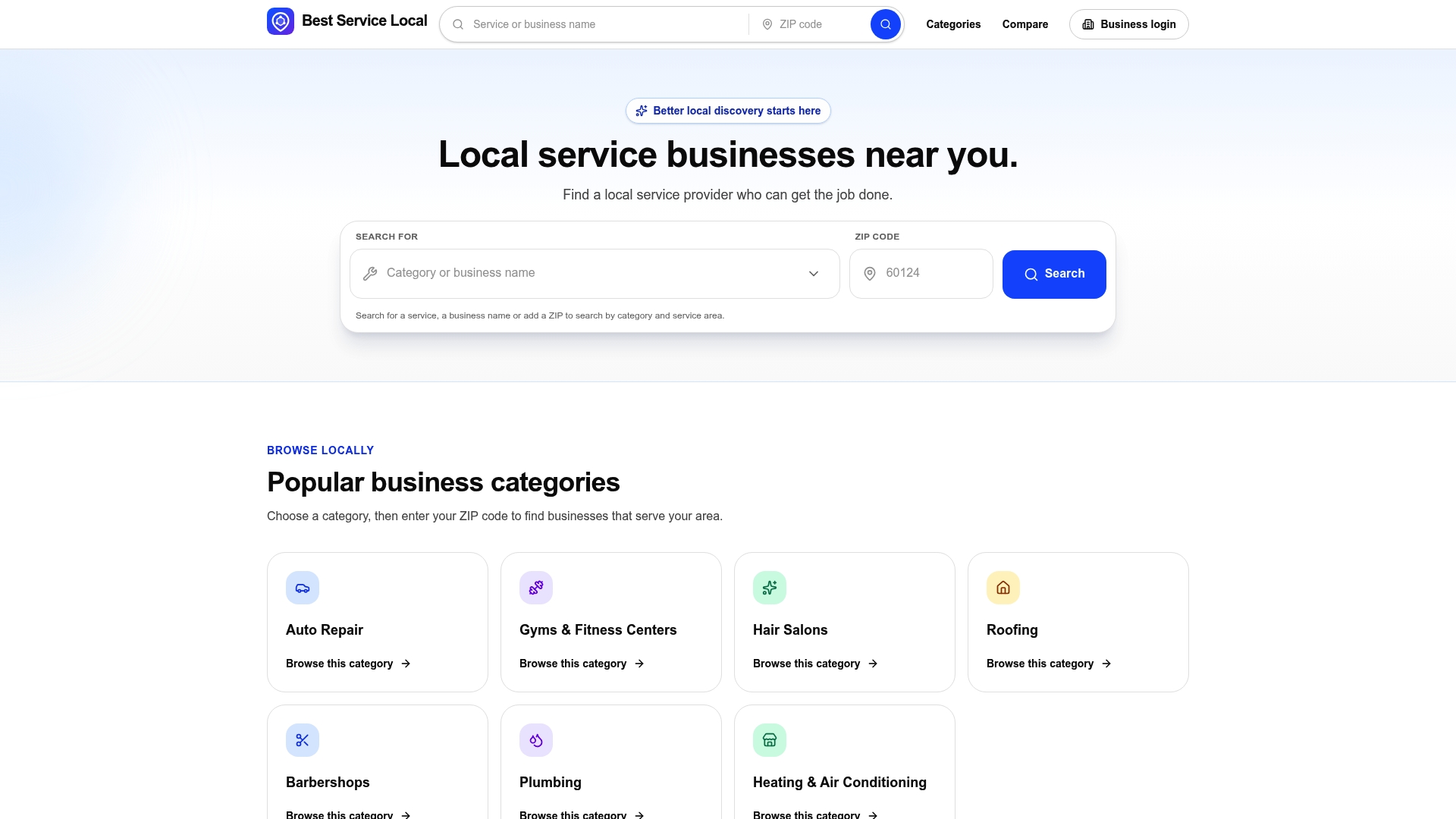
Search local businesses by service and ZIP code and compare providers near you.
Our perspective
Most people hear “bonded and insured” as one reassuring phrase. We think it is better treated as a short list of questions: which policy, what limit, which bond, which surety, and which license number.
That is why we built Best Service Local around ZIP code matching, business profiles and side-by-side comparison. When you can see several local providers in one place, in the same format, the differences in services and coverage area stand out, and you can bring your questions to each one with a clear idea of what you need.
Start local, compare, and ask for the paperwork before work begins. That sequence gets you to the right provider faster and with fewer surprises.
Service
FAQ
What does it mean when a company says it is bonded and insured?
It means the company has bought both a surety bond and business insurance. The bond protects customers if the company fails to meet its obligations, and the insurance pays for covered accidents and damage. Ask for the policy types, limits and bond details so you know exactly what is behind the phrase.
What is a bonded contractor?
A bonded contractor has a surety bond, a three-party agreement between the contractor, the customer or licensing body, and the bonding company. If a valid claim is made, the surety pays up to the bond limit and then collects the money back from the contractor. In some states, such as California, a license bond is required to hold a contractor license.
Is a bonded and insured contractor also licensed?
Not necessarily. A license is a separate permission from your state or local government, and requirements vary by state and trade. In some states the bond is a condition of getting the license, so check the licensing board’s lookup page for all three: license, insurance and bond.
Does insurance cover a contractor’s workers?
General liability generally does not. Injuries to the contractor’s own employees fall under workers’ compensation, which is a separate policy. Ask for proof of both before work starts at your home.
Sources
- What Does Bonded And Insured Mean? – Forbes Advisor
- What Does “Bonded and Insured” Mean for a Contractor – McKnight Insurance
- Commercial Insurance – Maryland Insurance Administration
- Contractor License Bonds: Everything You Need to Know – Procore
- Contractor Bonds vs. Insurance – Procore
- Contractor Bond and GL Insurance FAQs – CCIS Bonds
- How do I find the right licensed contractor? – CSLB
- CSLB Fast Facts: A Guide to Contractor License Bonds
- How to Obtain Surety Bonds – NASBP
- Always Verify Your Bond! – NASBP
- The Basic Bond Book
- How to Verify If An HVAC Contractor Is Licensed, Bonded & Insured – FilterBuy
- Moving Company Licenses in NH, MA, and Maine: Verify Before Paying