
Barber vs Salon: Which Chair Is Right for Your Hair?
Barber vs Salon: Which Chair Is Right for Your Hair?

Go to a barber for short, clipper-based cuts: fades, ttapers, buzz cuts, neck and edge cleanups, and beard work. Go to a salon stylist for longer hair, layers, color, chemical services, or a big change in shape. Plenty of people are well served by either, so the real question is what your hair needs this month and how often you want to be in the chair.
TL;DR
- Choose a barber for fades, tapers, buzz cuts, short men’s cuts and beard shaping, especially if you want a touch-up every few weeks.
- Choose a salon stylist for long or layered hair, color, perms, treatments, blowouts and anything that needs a consultation first.
- Every U.S. state licenses both professions, and training hours differ by state, so the license matters less than the portfolio.
- Barbershops often take walk-ins. Salons usually run on appointments and longer visits.
- Look at recent work and read reviews for the exact cut you want before you book.
Table of Contents
- What actually separates a barber from a salon stylist
- Services side by side
- When a barber is the better choice
- When a salon stylist is the better choice
- Training and licensing: what it does and does not tell you
- What the visit feels like
- What it costs and how to budget
- A quick decision guide
- How to choose the right person once you pick the type
- Our perspective
- Find a barber or salon near you
- FAQ
- Sources
What actually separates a barber from a salon stylist
The split began with who each trade served. The U.S. Bureau of Labor Statistics describes barbers as professionals who shampoo, cut and style hair mostly for male clients, and who may also trim beards and mustaches and offer facial and head shaving. Hairstylists and cosmetologists, by the same source, offer a wide range of hair services and may also provide skin, makeup and nail services.
In practice that history shows up in the tools and the habits of each chair:
- Barbershops are built around clippers, guards, trimmers and the straight razor. The core work is short hair, clean lines and fast, repeatable precision.
- Salons are built around scissors, color, heat tools and products. The core work is shaping length, building layers and changing hair chemically.
The labels are not as rigid as they sound. Many women get excellent short cuts from barbers, and many men have long hair that suits a stylist. Some stylists do a very good fade, and some barbers handle longer scissor cuts well. The job title tells you where someone started, and their portfolio tells you what they do best.
Services side by side
| What you want | Barber | Salon stylist |
|---|---|---|
| Fade, taper, skin fade | Core skill | Varies by stylist |
| Buzz cut or clipper cut | Core skill | Usually fine |
| Neckline and edge line-up | Core skill | Possible |
| Beard shaping and trim | Core skill | Not usually offered |
| Hot-towel straight-razor shave | Common where offered | Rare |
| Long hair, layers, face-framing | Varies by barber | Core skill |
| Color, highlights, balayage | Rare, depends on state license | Core skill |
| Perms and chemical straightening | Rare, depends on state license | Core skill |
| Blowout, updo, styling | Uncommon | Core skill |
| Treatments for dry or damaged hair | Uncommon | Common |
The BLS notes that, depending on the state, some barbers are licensed to bleach, color and highlight hair and to offer permanent-wave services. Your state’s rules shape what any given shop can legally do, so a barber who offers color is not unusual in some places and unheard of in others.
When a barber is the better choice
A barber makes sense when your hair is short and your priority is a crisp result you can repeat.
- Fades and tapers. Blending from skin to length with clippers is the daily work of a barber, and the difference between an average fade and a great one is large.
- Buzz cuts and short clipper cuts. Fast, even and inexpensive to maintain.
- Necklines, edges and line-ups. The sharp outline that makes a short cut look fresh.
- Beard work. Shaping, trimming and, at many shops, a hot-lather shave with a straight razor.
- Frequent maintenance. If you need a tidy-up every two to three weeks to keep a fade sharp, a shop that takes walk-ins fits that rhythm.
If you live near one, a neighborhood shop can also become a regular spot. On our platform you can see how a barbershop describes itself before you go. For example, V’s Barbershop lists haircuts, shaves and grooming products, and Famous Fadez Barbershop focuses on haircuts and fades. Sauvage Barber Parlor in South Elgin is another listed option for a traditional shop.
When a salon stylist is the better choice
A salon is the stronger pick when the job is about shape, color or condition rather than length reduction alone.
- Long or layered hair. Removing weight, building layers that fall correctly and shaping around the face is scissor work, and it is where salon training concentrates.
- Color. Highlights, bleach, toner, gloss and full color changes call for chemical training and a consultation.
- Curly and coily hair. Choose a stylist who specializes in your texture and can show you examples. A specialty in curls matters more than the shop type.
- Fine or thinning hair. A stylist can cut to build the appearance of fullness and recommend styling approaches.
- A big change. If you are moving from a long cut to a short one, or the reverse, a longer consultation helps you both agree on the result.
- Special occasions. Blowouts, updos and event styling are salon territory.
If you are weighing color techniques, our guide to balayage vs highlights helps you match a look to your lifestyle and upkeep. Salons also vary in philosophy: some, like this one offering natural hair color services, center on plant-based color and treatments aimed at hair health, which shows how much range there is once you step into the salon world. If you are in the Chicago suburbs, HIP Salon in Schaumburg, IL is one listed salon you can review.
Training and licensing: what it does and does not tell you
The BLS notes that every state requires barbers, hairstylists and cosmetologists to be licensed. That is a useful baseline: whichever chair you choose, the person should hold a state license. The path to it, though, varies by state and by profession.
- California: the Board of Barbering and Cosmetology requires at least 1,000 hours of training for a barbering course, with hours set aside for health and safety, disinfection and sanitation, chemical hair services, hairstyling, and shaving and beard trimming.
- Illinois: the statute requires 1,500 hours in the study of barbering over a period of not less than nine months nor more than three years, and a barber school may credit up to 1,000 hours of cosmetology school training toward that course.
- Delaware: the code sets 1,250 classroom hours for a barber license and 1,500 for a cosmetologist license, or 3,000 hours in an apprenticeship for either.
- Colorado: the statute lists 1,500 contact hours for barber and cosmetologist licenses and 1,200 for a hairstylist license.
Two things follow from this. First, the totals are similar in many states, so a barber is not a lesser-trained professional than a cosmetologist, only a differently trained one. Second, licensing is a floor. It confirms training and safety standards, but it cannot tell you whether someone is excellent at the specific cut you want. For that you need to see their work.
What the visit feels like
The experience differs as much as the haircut does.
Barbershop. Many shops accept walk-ins, and a clipper cut is quick. The atmosphere is often chatty, and some customers keep the same barber for years. Barbers and customers tend to talk about the neighborhood, sports and family, and the shop can work as a small community hub. A typical visit is short, so it slots easily into a lunch break or a Saturday morning.
Salon. Expect an appointment, a consultation at the start, and a longer visit. A shampoo, a cut and finishing with a dryer or iron often come as one service. A stylist may talk through your hair texture, growth patterns and daily routine before picking up scissors, which is exactly what you want if you are trying something new.

Neither is better in the abstract. If you know what you want and need it done quickly, the shop wins on convenience. If you need advice, the salon wins on time spent planning.

What it costs and how to budget
Barbershop cuts are generally simpler and shorter, so they tend to cost less than salon services, and salon prices climb when color or treatments are added. Prices vary a lot by city, shop and stylist experience, so use your own ZIP code rather than a national average. Our guide to haircut prices by ZIP code shows what people pay locally.
A few ways to budget sensibly:
- Count visits per year. A fade kept sharp every two to three weeks means many more visits than a layered cut that holds its shape for two months. A lower price per visit can still add up.
- Add the extras. Beard trims, shaves, color and treatments are priced separately in most places.
- Plan the tip. A $20 tip on a $40 haircut is 50%, which is generous. Many customers tip a smaller percentage of the service price, and the shop’s own policy or your regular barber or stylist can guide you.
- Match the service to the result. Paying more for a stylist makes sense for color or a restyle. For a standard short cut, a barber may deliver the same quality for less.
A quick decision guide
Ask yourself these questions in order:
- Is your hair longer than about three inches and you want shape or layers? Book a stylist.
- Do you want color, bleach or a chemical service? Book a stylist.
- Is your hair short and you want a fade, taper, buzz or line-up? Book a barber.
- Do you need a beard shaped or a hot-towel shave? Book a barber that lists it.
- Is your hair curly or coily? Look for the person with proven curl work, in either type of shop.
- Not sure? Pick the professional whose recent photos match your target cut, whatever the sign on the door says.
If your hair is past your ears and you want a new shape rather than just a shorter length, a salon is usually the safer bet. If you want the same short cut tidied on a regular schedule, a barber is built for it.
How to choose the right person once you pick the type
- Look at recent work. Ask to see photos of the exact cut or color you want, on hair like yours.
- Read reviews for the specific service. A five-star shop for fades tells you nothing about layers.
- Bring a reference photo. Show front, side and back if you can, and name the guard length or the amount you want removed.
- Check the license. Each state publishes how to verify one through its licensing board.
- Confirm availability. Ask whether walk-ins are welcome or whether you need to book.
- Compare more than one option. Side-by-side profiles save you from choosing on a guess.
Our perspective
Most people ask barber or salon as if one answer fits everyone. In our experience, the better question is who in your area does the thing you want, close to where you live and work.
That is why we built Best Service Local around service type and ZIP code. A barbershop and a hair salon can sit a few blocks apart and serve completely different needs, and a business profile with its services, location and contact details laid out makes the difference clear before you pick up the phone.
Our comparison tools are designed so you can view several providers side by side, whether you want a clean fade from a neighborhood barbershop or a color appointment at a full-service salon. We think the right choice is the one that fits your hair, your schedule and your budget, and that you should be able to see the options in one place.
Service
Find a barber or salon near you
Our directory lets you search by service type and ZIP code, so you only see businesses that operate in your area. Open a profile to see what a shop or salon offers, then compare a few side by side and reach out directly. Searching and comparing are free for you.
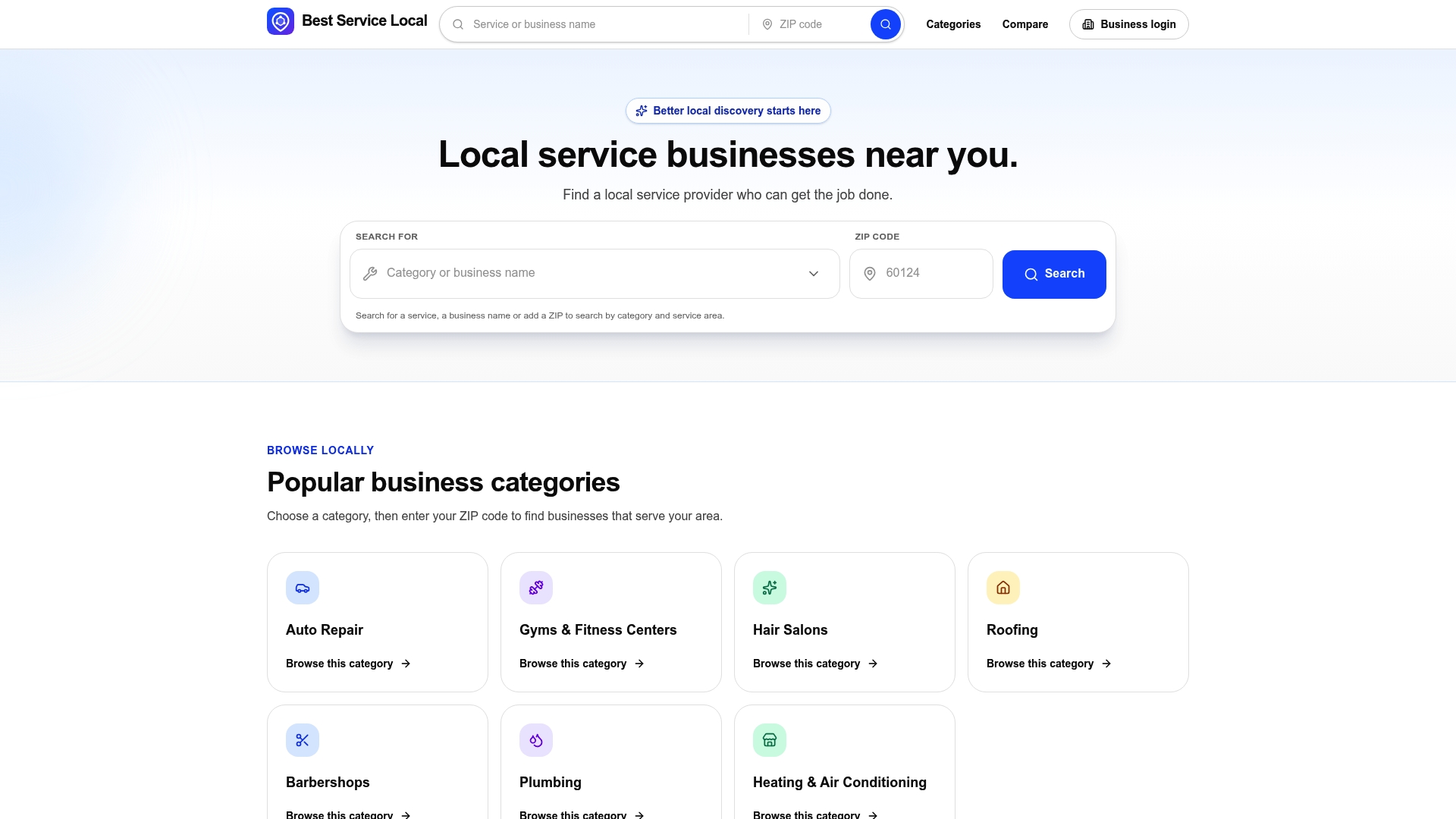
Start with local businesses by service and ZIP code, enter your ZIP code, and choose the hair or grooming category that matches the cut you want.
FAQ
What is the difference between a barber and a hairdresser?
A barber mostly cuts and styles short hair, often for men, and works with clippers, trimmers and straight razors. A hairdresser or stylist is trained across a wider range of hair services, including long cuts, color and chemical treatments. Both must be licensed by the state they work in.
Can a barber cut women’s hair, or a stylist cut men’s hair?
Yes, in both cases. Short cuts, tapers and clipper work suit a barber whoever the client is, and a stylist can cut any hair length with scissors. Choose by the cut you want and by the person’s portfolio rather than by gender.
Is a barber cheaper than a salon?
Usually, a simple barbershop cut costs less than a comparable salon service, because the cut is shorter and the menu is narrower. Color, treatments and styling raise salon totals. Prices differ by city, so check what local providers charge in your ZIP code.
Is a $20 tip good for a $40 haircut?
It is a very generous tip, since $20 is half the service price. Most clients leave a smaller percentage, and what you choose depends on the service and your regular provider. Cash tips are easy at a shop, and many salons accept tips by card.
Do I need an appointment at a barbershop?
Not always. Many barbershops welcome walk-ins, though busy times such as Saturdays can mean a wait. Salons generally work by appointment because services take longer. If timing matters, check the business profile or call ahead.
Sources
- U.S. Bureau of Labor Statistics: Barbers, Hairstylists, and Cosmetologists
- California Board of Barbering and Cosmetology: License Requirements
- Illinois Compiled Statutes, 225 ILCS 410/2-2
- Delaware Code Title 24, Chapter 51
- Colorado Revised Statutes 12-105-111