
Accountant vs Bookkeeper: Which Do You Need?
Accountant vs Bookkeeper: Which Do You Need?

A bookkeeper records your money as it moves. An accountant interprets those records, prepares your financial statements and taxes, and advises on what to do next. Most small businesses start with a bookkeeper, add an accountant for tax season and planning, and keep both as they grow. If you only file a simple personal return, you may need neither year-round, just a tax preparer once a year.
This guide explains the split in plain terms, what a CPA can do that others cannot, what tax preparation costs in the US, and how to choose and vet the right person locally.
TL;DR
- Bookkeeper: records and organizes daily transactions so your books are accurate and current.
- Accountant: uses those books to prepare statements and tax filings, and to advise on decisions.
- CPA: an accountant licensed by a state board, with authority to perform audits and represent clients before the IRS.
- Cost: the 2025 NATP fee study puts an average base Form 1040 with Schedules 1 to 3 at $280 for CPAs, $228 for Enrolled Agents and about $185 for non-credentialed preparers.
- Rule of thumb: start with clean books, then add an accountant as taxes or growth get complicated.
Table of Contents
- What a bookkeeper does
- What an accountant does
- Accountant vs bookkeeper at a glance
- Where the CPA fits
- When to hire a bookkeeper first
- When to hire an accountant
- Do you need a bookkeeper if you already have an accountant?
- What tax preparation costs
- How to choose and vet a provider
- A worked example
- Our perspective
- Find a local accountant or tax professional
- FAQ
- Sources
What a bookkeeper does
Bookkeeping is the record-keeping layer. A bookkeeper tracks day-to-day transactions, banking, overdue payments and wages, and sometimes produces basic financial statements, as Australia’s business.gov.au describes the role. In US practice, the work usually looks like this:
- Recording sales, purchases and expenses in the ledger
- Reconciling bank and credit card accounts each month
- Sending invoices and chasing late payments
- Running payroll entries and tracking payroll tax deposits
- Categorizing receipts so nothing is lost at year end
A professional bookkeepers’ association frames it through the nine-step accounting cycle: bookkeepers handle steps 1 to 3 (analyzing transactions, journalizing them and posting entries), and accountants take steps 4 to 9.
The bookkeeper’s output is not advice. It is accuracy. Everything an accountant later does depends on it.
What an accountant does
An accountant starts where the bookkeeper stops. According to a bookkeeping-versus-accounting overview, a bookkeeper maintains the ledgers, while an accountant analyzes, interprets and reports on that data to support strategic decisions. Typical accountant work includes:
- Preparing financial statements: profit and loss, balance sheet, cash flow
- Preparing and filing income tax returns
- Tax planning, such as timing income and expenses or choosing a business structure
- Analyzing margins, cash flow and growth
- Advising on hiring, equipment purchases, loans or an exit
The business.gov.au guidance lists a similar set: an accountant can analyze finances and advise on starting, expanding, tax, staff obligations and reporting.
Notice what this means for your week. A bookkeeper may touch your books weekly or monthly. An accountant often works at longer intervals: quarterly check-ins, year-end, and tax season.
Accountant vs bookkeeper at a glance
| Bookkeeper | Accountant | CPA | |
|---|---|---|---|
| Main job | Record and organize transactions | Analyze, report, prepare taxes, advise | Everything an accountant does, plus audit and attest work |
| Rhythm | Weekly or monthly | Quarterly, annually, as needed | Quarterly, annually, as needed |
| Output | Clean ledgers, reconciliations | Financial statements, tax returns, planning | Certified statements, audited reports, IRS representation |
| Credential | None required; voluntary Certified Bookkeeper designation | Varies; no single license for the title | State-licensed after the Uniform CPA Examination |
| Best for | Daily accuracy | Taxes and decisions | Complex filings, audits, IRS disputes |
Where the CPA fits
“Accountant” is a broad word. A CPA is a specific, licensed kind. A CPA is an accountant licensed by a state board after passing the Uniform CPA Examination and meeting education and experience requirements, and state law governs who may use titles such as CPA.
What that license adds in practice: a CPA can perform external audits and prepare and certify audited financial statements, and CPAs and enrolled agents can represent clients before the IRS. An accountant without those credentials can still advise on tax and prepare returns, but cannot do that audit work.

If you run a small shop, a handyman business or a gym, you will rarely need an audit. You may well need someone who can speak to the IRS for you if a notice arrives. Ask any preparer directly whether they hold a credential that allows representation, because titles overlap and a business card alone does not tell you who may sign a return or speak for you.
What about bookkeeper credentials?
Bookkeeping has no mandatory license. The Certified Bookkeeper designation is voluntary: it requires passing a four-part exam, at least two years of bookkeeping experience and signing a code of ethics. It is a useful signal when you compare candidates, though a strong bookkeeper without it can be perfectly good. Ask for references and a sample of their monthly reports.
When to hire a bookkeeper first
Start with a bookkeeper when your problem is disorder rather than strategy. Common signs:
- Receipts live in a shoebox, glovebox or phone camera roll
- You do not know your profit this month without guessing
- Business and personal spending run through the same card
- Invoices go out late, or you forget who still owes you
- You dread tax season mostly because the data is a mess
The general advice from a 2026 accounting software guide is to begin with a bookkeeper for daily transactions and invoices, then add an accountant for tax planning, forecasting and strategy as the business grows. The guide is written for UK readers, but the sequence holds in the US too. Accurate, current books also mean your accountant spends less time on cleanup and more on work that moves the business.
Bookkeepers also tend to charge lower fees than accountants, so fixing the records first is usually the cheaper route to a clean tax filing.
Trades and field businesses have a particular version of this problem. Time, materials and change orders are generated on job sites, and if they are not captured daily, the bookkeeper is guessing at month end. Practices like force account tracking show how signed daily records keep job costs defensible and easier to enter correctly.

When to hire an accountant
Bring in an accountant when the question is no longer “what happened?” but “what should I do?” or “how do I file this correctly?” The U.S. Chamber of Commerce advises hiring one if your taxes are complex, with multiple income streams or foreign investments, or if your business is growing rapidly.
More specific triggers:
- You are forming an LLC or S corporation, or deciding between them
- You have employees, contractors and sales tax obligations in more than one state
- You own rental property or several income sources
- You want a loan and the bank asks for professional statements
- You received an IRS or state notice
- You are buying equipment, a vehicle or another business
For individuals, the call is less clear-cut. You can track income and expenses yourself or combine your effort with professional help, and whether an accountant pays off depends mostly on how complicated your taxes are and how many accounts you manage. A W-2 job and a standard deduction rarely justify a standing relationship. A side business, investments and a home sale in one year often do.
Do you need a bookkeeper if you already have an accountant?
Often yes. An accountant’s engagement usually centers on tax preparation, planning and analysis, not on entering transactions every month. If nobody keeps the books current, your accountant either works from messy data, which costs more, or from stale data, which makes advice weaker.
Some accounting firms offer both services under one roof, and some small businesses with simple books use accounting software and a periodic accountant review in place of a standing bookkeeper. What matters is that someone owns the monthly records, and that you know who.
The reverse is also true: a bookkeeper is not a substitute for an accountant at filing time. Unless your bookkeeper also holds a tax credential, they should not be the one signing a complicated return or representing you in front of the IRS.
What tax preparation costs
Tax preparation is the cost most people actually search for, so here are real figures. The 2025 National Association of Tax Professionals fee study, reported by Accounting Today, found these averages for a base Form 1040 with Schedules 1 to 3:
| Preparer type | Average base fee (2025 study) |
|---|---|
| CPA | $280 |
| Enrolled Agent | $228 |
| Non-credentialed preparer | about $185 |
The same study shows location matters. Fees vary with credentials, market size, firm focus and experience: the average base 1040 plus three common schedules runs $185 in communities under 10,000 people and $233 in communities of 50,000 or more. Over half of preparers charge extra for a state return, and common add-ons are Schedule A (itemized deductions), Schedule C (self-employment) and Schedule D (capital gains).
Two practical takeaways:
- Your complexity sets the price more than your title does. A self-employed return with Schedule C costs more than a W-2 return at the same firm.
- Ask for a written quote that lists forms and state filings. Add-ons are where a quote becomes a bill.
These are 2025 averages for return preparation only. Ongoing bookkeeping and advisory work is priced differently, usually monthly or by project, so request quotes for the exact scope you need.
How to choose and vet a provider
Whoever you hire will see your bank accounts, payroll and tax identifiers. Vet carefully. The ICAEW, a UK professional body, suggests checking qualifications, training, experience, regulation, insurance, sector expertise, services, communication arrangements and fees before hiring an accountant. The list is UK-based, but it translates well. In the US, the same checklist looks like this:
- Credentials. Ask whether they are a CPA, an Enrolled Agent or a non-credentialed preparer, and verify any license with your state board of accountancy.
- Representation. Confirm they can represent you before the IRS if you receive a notice.
- Experience in your field. A contractor’s job costing, a gym’s membership revenue and a landlord’s depreciation schedule are different problems.
- Software and access. Find out which platform keeps your books and whether you keep ownership of the file.
- Communication. Agree on how often you will hear from them and how fast they answer.
- Fees. Get scope and price in writing: monthly or flat, what is included, what is extra.
- Security. Ask how they store and transmit your documents. Even paper records deserve protection, as this guide to protecting physical financial ledgers explains for home and business owners.
Then compare at least three. Our guide on getting multiple quotes for local services walks through how to ask each provider the same questions so the answers line up, and our piece on contractor background checks covers the verification mindset that applies to any professional you let into your finances.
A worked example
Say you run a two-person remodeling company. You invoice from a phone, pay subcontractors by check and card, and use one account for everything.
- Months 1 to 6: you hire a bookkeeper for a few hours a month. They separate business from personal spending, reconcile accounts and categorize job costs. You finally see profit by job.
- Month 7 onward: because the books are clean, you ask an accountant to review your structure. They suggest whether an entity change makes sense and set up quarterly estimated tax payments.
- Tax season: the accountant prepares the return from finished books instead of a pile of receipts, which usually means fewer questions and a smoother filing.
The same logic applies to a salon, a fitness studio or a property owner. If you own rentals, it also pays to understand the full cost of property management, because those fees flow through your books and your return. Likewise, if you price your own labor, knowing the typical handyman hourly rates helps you sanity-check the income side of your records.
Our perspective
Searching for a bookkeeper or accountant is a local decision more often than people expect. You want someone who knows your state’s filing rules, can meet you if a notice arrives, and understands businesses like yours in your area.
That is why we built Best Service Local around service type and ZIP code. Each business profile shows verified details and the services offered, and you can compare several providers side by side before you contact anyone. Our approach is designed to save you the guesswork: you see who actually operates where you are, what they offer, and how to reach them.
Our advice is simple. Compare at least three providers, ask each the same questions about credentials, scope and fees, and pick the one who explains things clearly. The best match is the one you will actually keep talking to.
Service
Find a local accountant or tax professional
Ready to talk to someone near you? Search by service type and ZIP code on Best Service Local, then compare profiles before you reach out. Two examples of listings you can browse are Motl Accounting in West Dundee, IL and Vohra Tax & Accounting, which lists tax and payroll services.
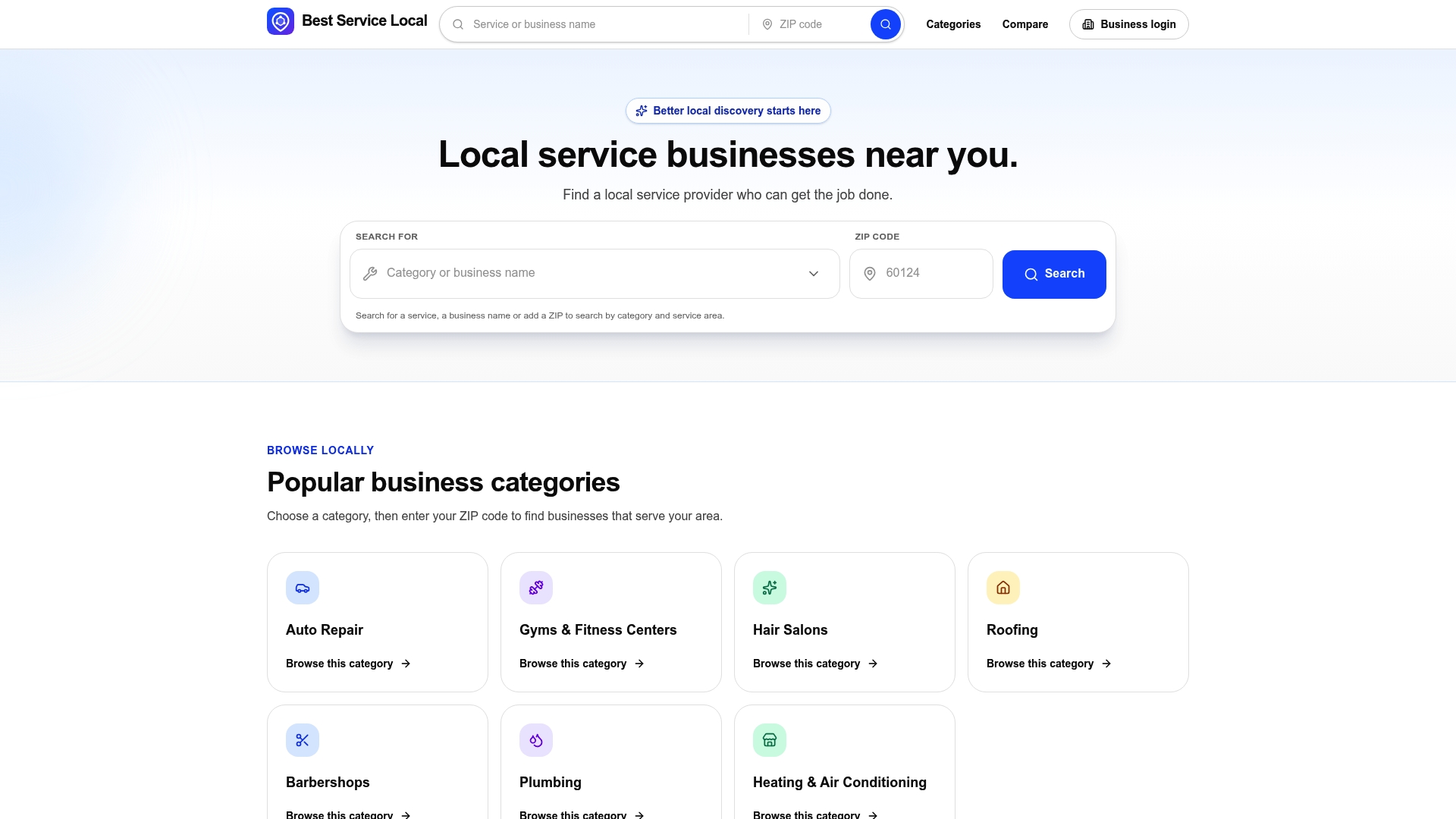
To see providers in your own area, search local businesses by service and ZIP code. Browsing and contacting providers is free for you.
FAQ
Is a bookkeeper cheaper than an accountant?
Usually, yes. Bookkeepers generally charge lower fees than accountants because the work is more transactional, so hiring one first is often the economical way to get your records in order. Actual rates depend on your location, volume of transactions and scope, so ask for written quotes.
Can an accountant do bookkeeping too?
Some do, but many do not. Accountants often work from books someone else maintains, and some firms offer both services separately. Ask up front whether monthly bookkeeping is part of the engagement or a separate fee.
What can an accountant do that a bookkeeper cannot?
An accountant can analyze your financial data, prepare financial statements, offer tax advice and prepare returns. A CPA can additionally perform audits and certify audited statements, and CPAs and enrolled agents can represent you before the IRS. A bookkeeper focuses on recording and organizing transactions.
How much does it cost to have a CPA do my taxes?
The 2025 NATP fee study reports an average of $280 for a CPA to prepare a base Form 1040 with Schedules 1 to 3. State returns and schedules for itemizing, self-employment or investments often cost extra, so get a quote listing every form.
When should I hire an accountant?
Hire one when your taxes get complex, such as multiple income streams or foreign investments, or when your business is growing quickly. Forming or changing a business entity, receiving an IRS notice, or applying for a loan are also good moments to call one.
Sources
- Bookkeeping versus accounting: main differences
- Setting up your finances checklist, business.gov.au
- Get help with your finances, business.gov.au
- The accounting cycle: bookkeeper and accountant responsibilities
- What can a CPA do that an accountant can’t?
- Bookkeeper vs accountant vs CPA: who does what
- Certified Bookkeeper designation self-study handbook
- Bookkeeper vs accountant: which does your business need?
- The difference between an accountant and a bookkeeper, U.S. Chamber of Commerce
- Do I need a personal accountant?
- What do tax preparers charge?, Accounting Today
- Hiring an accountant: a small business guide, ICAEW
- Force account tracking
- Protecting physical financial ledgers